• Request Information and / or Ad Pricing
  • Email us at: info@perm-ads.com
  • Phone: 1-844-504-7376
  • Contact Us

PERM Ads Immigration Advertising

Labor Certification Recruitment Ad Agency

PERM Labor Certification Advertising
PERM AD SERVICES
  • Home
    • PERM Recruitment Advertising Services
    • Close
  • PERM Overview
      • PERM Advertising Requirements
      • Newspaper of General Circulation
      • PERM Process Flow Chart
      • PERM Recruitment Atlanta, GA
      • PERM Recruitment Austin, TX
      • PERM Recruitment Chicago, IL
      • PERM Recruitment College Station, TX
      • PERM Recruitment Cupertino, CA
      • PERM Recruitment Dallas, TX
      • PERM Recruitment Edison, NJ
      • PERM Recruitment Houston, TX
      • PERM Recruitment Irving, TX
      • PERM Recruitment Jersey City, NJ
      • PERM Recruitment Los Angeles, CA
      • PERM Recruitment Menlo Park, CA
      • PERM Recruitment Miami, FL
      • PERM Recruitment Mountain View, CA
      • PERM Recruitment New York, NY
      • PERM Recruitment Palo Alto, CA
      • PERM Recruitment Plano, TX
      • PERM Recruitment Redmond, WA
      • PERM Recruitment San Diego, CA
      • PERM Recruitment San Francisco, CA
      • PERM Recruitment San Jose, CA
      • PERM Recruitment Santa Clara, CA
      • PERM Recruitment Seattle, WA
      • PERM Recruitment Sunnyvale, CA
      • PERM Recruitment Troy, MI
    • Close
  • Example PERM Ad
    • Sample PERM Advertisement
    • List of Newspapers Of General Circulation
    • Close
  • Immigration Advertising Services
      • Immigration Advertisement
      • Immigration Advertising Services
      • Immigration Advertising Agency
      • Immigration Recruitment Advertising
      • Immigration AdS Alpharetta GA
      • Immigration Ads Atlanta GA
      • Immigration Ads Austin TX
      • Immigration Ads Baltimore MD
      • Immigration Ads Boston MA
      • Immigration Ads Brooklyn NY
      • Immigration Ads Cambridge MA
      • Immigration Ads Charlotte NC
      • Immigration Ads Chicago IL
      • Immigration Ads Columbus OH
      • Immigration Ads Cupertino CA
      • Immigration Ads Dallas TX
      • Immigration Ads Edison NJ
      • Immigration Ads Fremont CA
      • Immigration Ads Hartford CT
      • Immigration Ads Houston TX
      • Immigration Ads Irvine CA
      • Immigration Ads Irving TX
      • Immigration Ads Jacksonville FL
      • Immigration Ads Jersey City NJ
      • Immigration Ads LA
      • Immigration Ads Miami FL
      • Immigration Ads Milpitas CA
      • Immigration Ads Nashville TN
      • Immigration Ads NY
      • Immigration Ads Philadelphia PA
      • Immigration Ads Phoenix AZ
      • Immigration Ads Pittsburgh PA
      • Immigration Ads Plano TX
      • Immigration Ads Princeton NJ
      • Immigration Ads Redmond WA
      • Immigration Ads Richardson TX
      • Immigration Ads Richmond VA
      • Immigration Ads San Antonio TX
      • Immigration Ads San Diego CA
      • Immigration Ads San Francisco CA
      • Immigration Ads Stamford CT
      • Immigration Ads Sunnyvale CA
      • Immigration Ads Washington D.C.
    • Close
  • PERM Ad Services
      • PERM Advertising
      • PERM Recruitment Advertising
      • PERM Employer Website
      • Online Job Boards
      • PERM Overview
      • PERM Advertising Agency
      • PERM Ads
      • Ad Agency PERM Advertisement
      • PERM Recruitment Advertising Services
      • PERM Immigration Ads
      • Immigration Advertisement Service
      • PERM Advertising Abbotsford WI
      • PERM Advertising Alpharetta GA
      • PERM Advertising Atlanta GA
      • PERM Advertising Austin TX
      • PERM Advertising Bellevue WA
      • PERM Advertising Boston MA
      • PERM Advertising Bridgewater NJ
      • PERM Advertising Cambridge MA
      • PERM Advertising Chandler AZ
      • PERM Advertising Charlotte NC
      • PERM Advertising Chicago IL
      • PERM Advertising College Station TX
      • PERM Advertising Dallas TX
      • PERM Advertising Edison NJ
      • PERM Advertising Farmington Hills MI
      • PERM Advertising Folsom CA
      • PERM Advertising Fremont CA
      • PERM Advertising Herndon VA
      • PERM Advertising Hillsboro OR
      • PERM Advertising Houston TX
      • PERM Advertising Irvine CA
      • PERM Advertising Irving TX
      • PERM Advertising Jersey City NJ
      • PERM Advertising Los Angeles CA
      • PERM Advertising Menlo Park CA
      • PERM Advertising Miami FL
      • PERM Advertising Milpitas CA
      • PERM Advertising Mountain View CA
      • PERM Advertising New Jersey
      • PERM Advertising New York
      • PERM Advertising Palo Alto CA
      • PERM Advertising Piscataway NJ
      • PERM Advertising Plano TX
      • PERM Advertising Pleasanton CA
      • PERM Advertising Redmond WA
      • PERM Advertising Redwood City CA
      • PERM Advertising Richardson TX
      • PERM Advertising San Antonio TX
      • PERM Advertising San Diego CA
    • Close
  • Labor Cert Ads
      • Labor Cert Ads Alpharetta GA
      • Labor Cert Ads Atlanta GA
      • Labor Cert Ads Austin TX
      • Labor Cert Ads Bellevue WA
      • Labor Cert Ads Boston MA
      • Labor Cert Ads Brooklyn NY
      • Labor Cert Ads Cambridge MA
      • Labor Cert Ads Chandler AZ
      • Labor Cert Ads Charlotte NC
      • Labor Cert Ads Chicago IL
      • Labor Cert Ads Cupertino CA
      • Labor Cert Ads Dallas TX
      • Labor Cert Ads Edison NJ
      • Labor Cert Ads Farmington Hills MI
      • Labor Cert Ads Folsom CA
      • Labor Cert Ads Fremont CA
      • Labor Cert Ads Herndon VA
      • Labor Cert Ads Houston TX
      • Labor Cert Ads Irvine CA
      • Labor Cert Ads Irving TX
      • Labor Cert Ads Iselin NJ
      • Labor Cert Ads Jersey City NJ
      • Labor Cert Ads Los Angeles CA
      • Labor Cert Ads Menlo Park CA
      • Labor Cert Ads Miami FL
      • Labor Cert Ads Milpitas CA
      • Labor Cert Ads Mountain View CA
      • Labor Cert Ads New Jersey
      • Labor Cert Ads New York
      • Labor Cert Ads Piscataway NJ
      • Labor Cert Ads Pittsburgh PA
      • Labor Cert Ads Plano TX
      • Labor Cert Ads Princeton NJ
      • Labor Cert Ads Redmond WA
      • Labor Cert Ads Reston VA
      • Labor Cert Ads Redwood Shores CA
      • Labor Cert Ads Richardson TX
      • Labor Cert Ads San Diego CA
      • Labor Cert Ads San Francisco CA
      • Labor Cert Ads San Jose CA
      • Labor Cert Ads Santa Clara CA
      • Labor Cert Ads Seattle WA
      • Labor Cert Ads Sunnyvale CA
      • Labor Cert Ads Tampa FL
      • Labor Cert Ads Troy MI
      • Labor Cert Ads Washington DC
      • Labor Cert Ads Woburn MA
    • Close
  • SWA Job Order
      • State Workforce Agency Directory
      • SWA Job Order Tips: Employer Registration and Verification
      • Alabama SWA Job Order
      • Alaska SWA Job Order
      • Arizona SWA Job Order
      • Arkansas SWA Job Order
      • California SWA Job Order
      • Colorado SWA Job Order
      • Connecticut SWA Job Order
      • Delaware SWA Job Order
      • Dist. of Colum. SWA Job Order
      • Florida SWA Job Order
      • Georgia SWA Job Order
      • Hawaii SWA Job Order
      • Idaho SWA Job Order
      • Illinois SWA Job Order
      • Indiana SWA Job Order
      • Iowa SWA Job Order
      • Kansas SWA Job Order
      • Kentucky SWA Job Order
      • Louisiana SWA Job Order
      • Maine SWA Job Order
      • Maryland SWA Job Order
      • Massachusetts SWA Job Order
      • Michigan SWA Job Order
      • Minnesota SWA Job Order
      • Mississippi SWA Job Order
      • Missouri SWA Job Order
      • Montana SWA Job Order
      • Nebraska SWA Job Order
      • Nevada SWA Job Order
      • New Hampshire SWA Job Order
      • New Jersey SWA Job Order
      • New Mexico SWA Job Order
      • New York SWA Job Order
      • North Carolina SWA Job Order
      • North Dakota SWA Job Order
      • Ohio SWA Job Order
      • Oklahoma SWA Job Order
      • Oregon SWA Job Order
      • Pennsylvania SWA Job Order
      • South Carolina SWA Job Order
      • South Dakota SWA Job Order
      • Tennessee SWA Job Order
      • Texas SWA Job Order
      • Utah SWA Job Order
      • Vermont SWA Job Oder
      • Virginia Job Order SWA
      • Washington SWA Job Order
      • West Virginia SWA Job Order
      • Wisconsin SWA Job Order
      • Wyoming SWA Job Order
    • Close
  • PERM News Ads
      • Newspaper Of General Circulation
      • Akron Beacon Journal | Ohio
      • Albuquerque Journal | New Mexico
      • Arizona Daily Star | Arizona
      • Arizona Republic | Arizona
      • Arkansas Democrat-Gazette | Arkansas
      • Asbury Park Press | New Jersey
      • Austin American-Statesman | Texas
      • Baltimore Sun | Maryland
      • Birmingham News | Alabama
      • Boston Herald | Massachusetts
      • Chicago Sun-Times
      • Chicago Tribune
      • Contra Costa Times | California
      • Daily Herald | Illinois
      • Daily News | New York
      • Daily Press | VA
      • Dayton Daily News | Ohio
      • Democrat and Chronicle | New York
      • Detroit Free Press
      • Fort Worth Star-Telegram | Texas
      • Fresno Bee | California
      • Grand Rapids Press | Michigan
      • Houston Chronicle
      • Investor’s Business Daily | California
      • Knoxville News Sentinel | Tennessee
      • Las Vegas Review-Journal | Nevada
      • Lexington Herald-Leader | Kentucky
      • Los Angeles Daily News | California
      • Miami Herald
      • Miami Herald | Florida
      • Milwaukee Journal Sentinel | Wisconsin
      • New York Post
      • News & Observer | North Carolina
      • Newsday | New York
      • Omaha World-Herald | Nebraska
      • Orlando Sentinel | Florida
      • Pittsburgh Post-Gazette | Pennsylvania
      • Pittsburgh Tribune-Review | Pennsylvania
      • Press-Register | Alabama
      • Press-Register | Mobile, Alabama
    • Close
  • PERM Local Papers
      • Alabama Local Newspapers
      • Alaska Local Newspapers
      • Arizona Local Newspapers
      • California Local Papers
      • Colorado Local Newspapers
      • Connecticut Local Newspapers
      • Florida Local Newspapers
      • Georgia Local Newspapers
      • Hawaii Local Newspapers
      • Idaho Local Newspapers
      • Illinois Local Newspapers
      • Kentucky Local Newspapers
      • New Mexico Local Newspapers
      • New York Local Newspapers
    • Close
  • PERM Radio Ads
      • Radio Ad Script Form
      • Radio Ads Arlington VA
      • Radio Ads Atlanta GA
      • Radio Ads Augusta GA
      • Radio Ads Austin TX
      • Radio Ads Bakersfield CA
      • Radio Ads Baltimore MD
      • Radio Ads Bellevue WA
      • Radio Ads Berkeley CA
      • Radio Ads Boston MA
      • Radio Ads Bridgeport CT
      • Radio Ads Brownsville TX
      • Radio Ads Buffalo NY
      • Radio Ads Burbank CA
      • Radio Ads Cambridge MA
      • Radio Ads Cape Coral FL
      • Radio Ads Carlsbad CA
      • Radio Ads Carrollton TX
      • Radio Ads Cary NC
      • Radio Ads Charlotte NC
      • Radio Ads Chicago IL
      • Radio Ads Cincinnati Ohio
      • Radio Ads Clearwater FL
      • Radio Ads Concord
      • Radio Ads Coral Springs FL
      • Radio Ads Corpus Christi TX
      • Radio Ads Costa Mesa CA
      • Radio Ads Dallas TX
      • Radio Ads Daly City CA
      • Radio Ads Davenport Iowa
      • Radio Ads Dayton Ohio
      • Radio Ads Denton Texas
      • Radio Ads Denver Colorado
      • Radio Ads Des Moines Iowa
      • Radio Ads Detroit Michigan
      • Radio Ads Downey California
      • Radio Ads Durham
      • Radio Ads El Cajon California
      • Radio Ads El Monte California
      • Radio Ads El Paso Texas
      • Radio Ads Elgin Illinois
      • Radio Ads Elizabeth New Jersey
      • Radio Ads Elk Grove California
      • Radio Ads Erie Pennsylvania
      • Radio Ads Escondido California
      • Radio Ads Eugene Oregon
      • Radio Ads Evansville Indiana
      • Radio Ads Everett Washington
      • Radio Ads Fairfield California
      • Radio Ads Fargo North Dakota
      • Radio Ads Fayetteville North Carolina
      • Radio Ads Flint Michigan
      • Radio Ads Fontana California
      • Radio Ads Fort Collins Colorado
      • Radio Ads Fort Lauderdale Florida
      • Radio Ads Fort Worth Texas
      • Radio Ads Fremont California
      • Radio Ads Fresno California
      • Radio Ads Fullerton California
      • Radio Ads Gainesville Florida
      • Radio Ads Glendale California
      • Radio Ads Glendale California
      • Radio Ads Green Bay Wisconsin
      • Radio Ads Greensboro North Carolina
      • Radio Ads Hartford Connecticut
      • Radio Ads Hayward California
      • Radio Ads Henderson
      • Radio Ads Honolulu Hawaii
      • Radio Ads Houston Texas
      • Radio Ads Huntington Beach California
      • Radio Ads Indianapolis Indiana
      • Radio Ads Irvine California
      • Radio Ads Irving Texas
      • Radio Ads Jersey City NJ
      • Radio Ads Kansas City MO
      • Radio Ads Lafayette GA
      • Radio Ads Lancaster CA
      • Radio Ads Laredo Texas
      • Radio Ads Las Vegas NV
      • Radio Ads Lexington KY
      • Radio Ads Long Beach CA
      • Radio Ads Los Angeles CA
      • Radio Ads Madison WI
      • Radio Ads Manchester New Hampshire
      • Radio Ads McAllen Texas
      • Radio Ads McKinney Texas
      • Radio Ads Memphis Tennessee
      • Radio Ads Mesa Arizona
      • Radio Ads Mesquite Texas
      • Radio Ads Miami Florida
      • Radio Ads Miami Gardens Florida
      • Radio Ads Midland
      • Radio Ads Milwaukee Wisconsin
      • Radio Ads Minneapolis Minnesota
      • Radio Ads Miramar
      • Radio Ads Mobile
      • Radio Ads Modesto California
      • Radio Ads Montgomery Alabama
      • Radio Ads Moreno Valley California
      • Radio Ads Murfreesboro Tennessee
      • Radio Ads Murrieta California
      • Radio Ads Naperville Illinois
      • Radio Ads Nashville Tennessee
      • Radio Ads New Haven Connecticut
      • Radio Ads New Orleans Louisiana
      • Radio Ads New York New York
      • Radio Ads Newark New Jersey
      • Radio Ads Newport News Virginia
      • Radio Ads Norfolk
      • Radio Ads Norman
      • Radio Ads North Charleston South Carolina
      • Radio Ads North Las Vegas Nevada
      • Radio Ads Norwalk California
      • Radio Ads Oakland California
      • Radio Ads Oceanside California
      • Radio Ads Odessa Texas
      • Radio Ads Oklahoma City Oklahoma
      • Radio Ads Olathe Kansas
      • Radio Ads Omaha Nebraska
      • Radio Ads Ontario
      • Radio Ads Orange
      • Radio Ads Orlando Florida
      • Radio Ads Overland Park Kansas
      • Radio Ads Oxnard California
      • Radio Ads Palm Bay Florida
      • Radio Ads Palmdale California
      • Radio Ads Pasadena California
      • Radio Ads Philadelphia Pennsylvania
      • Radio Ads Phoenix Arizona
      • Radio Ads Pittsburgh Pennsylvania
      • Radio Ads Plano Texas
      • Radio Ads Pomona
      • Radio Ads Pompano Beach Florida
      • Radio Ads Portland Oregon
      • Radio Ads Providence Rhode Island
      • Radio Ads Raleigh North Carolina
      • Radio Ads Reno Nevada
      • Radio Ads Richardson Texas
      • Radio Ads Richmond
      • Radio Ads Richmond California
      • Radio Ads Riverside
      • Radio Ads Rochester New York
      • Radio Ads Roseville California
      • Radio Ads Sacramento California
      • Radio Ads Saint Paul Minnesota
      • Radio Ads Salem
      • Radio Ads Salinas California
      • Radio Ads San Antonio
      • Radio Ads San Bernardino California
      • Radio Ads San Diego California
      • Radio Ads San Francisco California
      • Radio Ads San Jose California
      • Radio Ads Santa Ana California
      • Radio Ads Santa Clara California
      • Radio Ads Santa Clarita California
      • Radio Ads Santa Rosa California
      • Radio Ads Savannah Georgia
      • Radio Ads Seattle Washington
      • Radio Ads Simi Valley California
      • Radio Ads Spokane Washington
      • Radio Ads St. Louis Missouri
      • Radio Ads St. Petersburg FL
      • Radio Ads Stamford CT
      • Radio Ads Sterling Heights Michigan
      • Radio Ads Stockton California
      • Radio Ads Sunnyvale California
      • Radio Ads Syracuse New York
      • Radio Ads Tacoma Washington
      • Radio Ads Tallahassee
      • Radio Ads Tampa Florida
      • Radio Ads Temecula California
      • Radio Ads Thousand Oaks California
      • Radio Ads Ventura California
      • Radio Ads Virginia Beach Virginia
      • Radio Ads Visalia California
      • Radio Ads Washington
      • Radio Ads West Palm Beach Florida
      • Radio Ads Wilmington North Carolina
      • Radio Ads Winston–Salem North Carolina
    • Close
  • LINKS
  • Blog
  • Contact
  • [ FREE PRICE QUOTES! ]

Archives for August 2020

State Department Rule All But Kills Ban on Foreign-Worker Admissions

August 14, 2020 by PERM News

No, ’tis not so deep as a well nor so wide as a church-door, but ’tis enough, ’twill serve.

— Romeo and Juliet

Like the wound suffered by Shakespeare’s Mercutio, the State Department’s August 12 ruling regarding exceptions to the recently announced ban on foreign worker admissions will be a fatal one (except in a handful of cases). For an account of the earlier order, dated June 22, see here.

By my count, the newly announced exceptions will cover eight different classes of foreign workers under a myriad of different kinds of exceptions (or excuses) listed in seven pages of single-line text, which is 3,101 words long.

According to an immigration lawyer, quoted by Law 360:

[T]he new exemptions will likely still keep entry-level hires blocked from entering the U.S. on new visas, but will allow more essential and experienced employees to take jobs in the U.S.

“It feels like a real unraveling of the proclamation,” she said. “I think this looks like the government bending to pressure from the private sector.”

My colleague John Miano, also a lawyer, makes a broader statement: “If you go through them you will find that everyone is exempted.”

The classes of foreign workers excepted, under a variety of different circumstances, include H-1B (“highly skilled” workers), H-2B (non skilled, non-ag workers), H-4 (spouses, usually, of H-1Bs), J-1 (exchange students and scholars), J-2 (the latter’s spouses and children), L-1A and L-1B (employees of multi-national corporations), and L-2 (their spouses and children). H-2A farmworkers were exempted under earlier rulings.

Every one of these aliens is entitled to work in the United States once they secure the needed visa.

The circumstances under which a waiver can be granted (by a U.S. consular officers) include:

  • Those “seeking to resume ongoing employment in the United States in the same position with the same employer and visa classification”;
  • Individuals “whose travel would be in the national interest, as determined by the Secretary of State, the Secretary of Homeland Security, or their respective designees”; and
  • “National interest exceptions … for those who will accompany or follow to join a principal applicant who is a spouse or parent and who has been granted a national interest exception to P.P. 10052.”

None of these exceptions are needed by foreign workers already in the country, just those on the outside seeking to return or to take up new jobs.

So what do we have left of the earlier order? It would appear that some new hires among foreign workers who are currently outside of the nation will not get visas. Those returning from abroad will have to get permission from our already overworked consular officers, which will mean delayed returns for some to many. Then there is an anomaly in the State Department’s new policy statement — I did not see any provision for granting renewed visas to F visa holders who have those subsidized Optional Practical Training jobs. Most probably are not out of the country and do not need them.

And, of course, this is another indication that the Trump administration seems not to want to inconvenience the private sector by seriously reducing the foreign worker population.

Source: State Department Rule All But Kills Ban on Foreign-Worker Admissions
Filed Under: immigration-news

 DOS Update to National Interest Exceptions to Presidential Proclamations 10014 & 10052

August 13, 2020 by PERM News

State Department, Aug. 12, 2020

“On June 22, the President signed Presidential Proclamation (P.P.) 10052, which extends P.P. 10014, which suspended the entry to the United States of certain immigrant visa applicants, through December 31, 2020. P.P. 10052 also suspends the entry to the United States of certain additional foreign nationals who present a risk to the U.S. labor market during the economic recovery following the 2019 novel coronavirus outbreak.  Specifically, the suspension applies to applicants for H-1B, H-2B, and L-1 visas; J-1 visa applicants participating in the intern, trainee, teacher, camp counselor, au pair, or summer work travel programs; and any spouses or children of covered applicants applying for H-4, L-2, or J-2 visas.

The Proclamation does not apply to applicants who were in the United States on the effective date of the Proclamation (June 24), or who had a valid visa in the classifications mentioned above (and plans to enter the United States on that visa), or who had another official travel document valid on the effective date of the Proclamation. If an H-1B, H-2B, L-1, or J-1 non-immigrant is not subject to the Proclamation, then neither that individual nor the individual’s spouse or children will be prevented from obtaining a visa due to the Proclamation.  The Department of State is committed to implementing this Proclamation in an orderly fashion in conjunction with the Department of Homeland Security and interagency partners and in accordance with all applicable laws and regulations.

Both P.P. 10014 and 10052 include exceptions, including an exception for individuals whose travel would be in the national interest, as determined by the Secretary of State, the Secretary of Homeland Security, or their respective designees.  The list below is a non-exclusive list of the types of travel that may be considered to be in the national interest, based on determinations made by the Assistant Secretary of State for Consular Affairs, exercising the authority delegated to him by the Secretary of State under Section 2(b)(iv) of P.P. 10014 and 3(b)(iv) of P.P. 10052.

Until complete resumption of routine visa services, applicants who appear to be subject to entry restrictions under P.P. 10014, P.P. 10052, and/or regional-focused Presidential Proclamations related to COVID-19 (P.P. 9984, 9992, 9993, 9996, and/ or 10041) might not be processed for a visa interview appointment unless the applicant also appears to be eligible for an exception under the applicable Proclamation(s).  Applicants who are subject to any of these Proclamations, but who believe they may qualify for a national interest exception or other exception, should follow the instructions on the nearest U.S. Embassy or Consulate’s website regarding procedures necessary to request an emergency appointment and should provide specific details as to why they believe they may qualify for an exception.  While a visa applicant subject to one or more Proclamations might meet an exception, the applicant must first be approved for an emergency appointment request and a final determination regarding visa eligibility will be made at the time of visa interview.  Please note that U.S. Embassies and Consulates may only be able to offer limited visa services due to the COVID-19 pandemic, in which case they may not be able to accommodate your request unless the proposed travel is deemed emergency or mission critical.  Prospective visa applicants should visit the website for Embassy or Consulate where they intend to apply for a visa to get updates on current operating status.  Travelers who are subject to a regional COVID-19 Proclamation but who do not require a visa, such as ESTA travelers (i.e., those traveling on the Visa Waiver Program), should also follow the guidance on the nearest Embassy or Consulate’s website for how to request consideration for a national interest exception.

Exceptions under P.P. 10052 for certain travel in the national interest by nonimmigrants may include the following:

H-1B applicants:

  • For travel as a public health or healthcare professional, or researcher to alleviate the effects of the COVID-19 pandemic, or to conduct ongoing medical research in an area with a substantial public health benefit (e.g. cancer or communicable disease research). This includes those traveling to alleviate effects of the COVID-19 pandemic that may be a secondary effect of the pandemic (e.g., travel by a public health or healthcare professional, or researcher in an area of public health or healthcare that is not directly related to COVID-19, but which has been adversely impacted by the COVID-19 pandemic).
  • Travel supported by a request from a U.S. government agency or entity to meet critical U.S. foreign policy objectives or to satisfy treaty or contractual obligations. This would include individuals, identified by the Department of Defense or another U.S. government agency, performing research, providing IT support/services, or engaging other similar projects essential to a U.S. government agency.
  • Travel by applicants seeking to resume ongoing employment in the United States in the same position with the same employer and visa classification.  Forcing employers to replace employees in this situation may cause financial hardship.  Consular officers can refer to Part II, Question 2 of the approved Form I-129 to determine if the applicant is continuing in “previously approved employment without change with the same employer.”
  • Travel by technical specialists, senior level managers, and other workers whose travel is necessary to facilitate the immediate and continued economic recovery of the United States.  Consular officers may determine that an H-1B applicant falls into this category when at least two of the following five indicators are present:
  1. The petitioning employer has a continued need for the services or labor to be performed by the H-1B nonimmigrant in the United States.  Labor Condition Applications (LCAs) approved by DOL during or after July 2020 are more likely to account for the effects of the COVID-19 pandemic on the U.S. labor market and the petitioner’s business; therefore, this indicator is only present for cases with an LCA approved during or after July 2020 as there is an indication that the petitioner still has a need for the H-1B worker.  For LCAs approved by DOL before July 2020, this indicator is only met if the consular officer is able to determine from the visa application the continuing need of petitioned workers with the U.S. employer.  Regardless of when the LCA was approved, if an applicant is currently performing or is able to perform the essential functions of the position for the prospective employer remotely from outside the United States, then this indicator is not present.
  2. The applicant’s proposed job duties or position within the petitioning company indicate the individual will provide significant and unique contributions to an employer meeting a critical infrastructure need.  Critical infrastructure sectors are chemical, communications, dams, defense industrial base, emergency services, energy, financial services, food and agriculture, government facilities, healthcare and public health, information technology, nuclear reactors, transportation, and water systems.  Employment in a critical infrastructure sector alone is not sufficient; the consular officers must establish that the applicant holds one of the two types of positions noted below:a.)    Senior level placement within the petitioning organization or job duties reflecting performance of functions that are both unique and vital to the management and success of the overall business enterprise; ORb.)    The applicant’s proposed job duties and specialized qualifications indicate the individual will provide significant and unique contributions to the petitioning company.
  3. The wage rate paid to the H-1B applicant meaningfully exceeds the prevailing wage rate by at least 15 percent (see Part F, Questions 10 and 11 of the LCA) by at least 15 percent.  When an H-1B applicant will receive a wage that meaningfully exceeds the prevailing wage, it suggests that the employee fills an important business need where an American worker is not available.
  4. The H-1B applicant’s education, training and/or experience demonstrate unusual expertise in the specialty occupation in which the applicant will be employed.  For example, an H-1B applicant with a doctorate or professional degree, or many years of relevant work experience, may have such advanced expertise in the relevant occupation as to make it more likely that he or she will perform critically important work for the petitioning employer.
  5. Denial of the visa pursuant to P.P. 10052 will cause financial hardship to the U.S. employer.  The following examples, to be assessed based on information from the visa application, are illustrative of what may constitute a financial hardship for an employer if a visa is denied: the employer’s inability to meet financial or contractual obligations; the employer’s inability to continue its business; or a delay or other impediment to the employer’s ability to return to its pre-COVID-19 level of operations.

H-2B applicants

  • Travel based on a request from a U.S. government agency or entity to meet critical foreign policy objectives or to satisfy treaty or contractual obligations. An example of this would be supporting U.S. military base construction (e.g. associated with the National Defense Authorization Act) or IT infrastructure.
  • Travel necessary to facilitate the immediate and continued economic recovery of the United States (e.g. those working in forestry and conservation, nonfarm animal caretakers, etc).  Consular officers may determine that an H-2B applicant falls into this category when at least two of the following three indicators are present:
  1. The applicant was previously employed and trained by the petitioning U.S. employer.  The applicant must have previously worked for the petitioning U.S. employer under two or more H-2B (named or unnamed) petitions.  U.S. employers dedicate substantial time and resources to training seasonal/temporary staff, and denying visas to the most experienced returning workers may cause financial hardship to the U.S. business.
  2. The applicant is traveling based on a temporary labor certification (TLC) that reflects continued need for the worker.  TLCs approved by DOL during or after July 2020 are more likely to account for the effects of the COVID-19 pandemic on the U.S. labor market and the petitioner’s business, and therefore this indicator is only present for cases with a TLC approved during or after July 2020 as there is an indication that the petitioner still has a need for the H-2B worker.  For TLCs approved by DOL before July 2020, this indicator is only met if the consular officer is able to determine from the visa application the continuing need of petitioned workers with the U.S. employer.
  3. Denial of the visa pursuant to P.P. 10052 will cause financial hardship to the U.S. employer.  The following examples, to be assessed based on information from the visa application, are illustrative of what may constitute a financial hardship for an employer if a visa is denied: the employer’s inability to meet financial or contractual obligations; the employer’s inability to continue its business; or a delay or other impediment to the employer’s ability to return to its pre-COVID-19 level of operations.

J-1 applicants

  • Travel to provide care for a minor U.S. citizen, LPR, or nonimmigrant in lawful status by an au pair possessing special skills required for a child with particular needs (e.g., medical, special education, or sign language).  Childcare services provided for a child with medical issues diagnosed by a qualified medical professional by an individual who possesses skills to care for such child will be considered to be in the national interest.
  • Travel by an au pair that prevents a U.S. citizen, lawful permanent resident, or other nonimmigrant in lawful status from becoming a public health charge or ward of the state of a medical or other public funded institution.
  • Childcare services provided for a child whose parents are involved with the provision of medical care to individuals who have contracted COVID-19 or medical research at United States facilities to help the United States combat COVID-19.
  • An exchange program conducted pursuant to an MOU, Statement of Intent, or other valid agreement or arrangement between a foreign government and any federal, state, or local government entity in the United States that is designed to promote U.S. national interests if the agreement or arrangement with the foreign government was in effect prior to the effective date of the Presidential Proclamation.
  • Interns and Trainees on U.S. government agency-sponsored programs (those with a program number beginning with “G-3” on Form DS-2019): An exchange visitor participating in an exchange visitor program in which he or she will be hosted by a U.S. government agency and the program supports the immediate and continued economic recovery of the United States.
  • Specialized Teachers in Accredited Educational Institutions with a program number beginning with “G-5” on Form DS-2019: An exchange visitor participating in an exchange program in which he or she will teach full-time, including a substantial portion that is in person, in a publicly or privately operated primary or secondary accredited educational institution where the applicant demonstrates ability to make a specialized contribution to the education of students in the United States.  A “specialized teacher” applicant must demonstrate native or near-native foreign language proficiency and the ability to teach his/her assigned subject(s) in that language.
  • Critical foreign policy objectives: This only includes programs where an exchange visitor participating in an exchange program that fulfills critical and time sensitive foreign policy objectives.

L-1A applicants

  • Travel as a public health or healthcare professional, or researcher to alleviate the effects of the COVID-19 pandemic, or to conduct ongoing medical research in an area with a substantial public health benefit.  This includes those traveling to alleviate effects of the COVID-19 pandemic that may be a secondary effect of the pandemic.
  • Travel based on a request from a U.S. government agency or entity to meet critical foreign policy objectives or satisfy treaty or contractual obligations.  An example of this would be supporting U.S. military base construction or IT infrastructure.
  • Travel by applicants seeking to resume ongoing employment in the United States in the same position with the same employer and visa classification.   Forcing employers to replace employees in this situation may cause undue financial hardship.
  • Travel by a senior level executive or manager filling a critical business need of an employer meeting a critical infrastructure need. Critical infrastructure sectors include chemical, communications, dams, defense industrial base, emergency services, energy, financial services, food and agriculture, government facilities, healthcare and public health, information technology, nuclear reactors, transportation, and water systems.  An L-1A applicant falls into this category when at least two of the following three indicators are present AND the L-1A applicant is not seeking to establish a new office in the United States:
  1. Will be a senior-level executive or manager;
  2. Has spent multiple years with the company overseas, indicating a substantial knowledge and expertise within the organization that can only be replicated by a new employee within the company following extensive training that would cause the employer financial hardship; or
  3. Will fill a critical business need for a company meeting a critical infrastructure need.

L-1A applicants seeking to establish a new office in the United States likely do NOT fall into this category, unless two of the three criteria are met AND the new office will employ, directly or indirectly, five or more U.S. workers.

L-1B applicants

  • Travel as a public health or healthcare professional, or researcher to alleviate the effects of the COVID-19 pandemic, or to conduct ongoing medical research in an area with a substantial public health benefit. This includes those traveling to alleviate effects of the COVID-19 pandemic that may be a secondary effect of the pandemic.
  • Travel based on a request from a U.S. government agency or entity to meet critical foreign policy objectives or satisfy treaty or contractual obligations. An example of this would be supporting U.S. military base construction or IT infrastructure.
  • Travel by applicants seeking to resume ongoing employment in the United States in the same position with the same employer and visa classification.  Forcing employers to replace employees in this situation may cause undue financial hardship.
  • Travel as a technical expert or specialist meeting a critical infrastructure need.  The consular officer may determine that an L-1B applicant falls into this category if all three of the following indicators are present:
  1. The applicant’s proposed job duties and specialized knowledge indicate the individual will provide significant and unique contributions to the petitioning company;
  2. The applicant’s specialized knowledge is specifically related to a critical infrastructure need; AND
  3. The applicant has spent multiple years with the company overseas, indicating a substantial knowledge and expertise within the organization that can only be replicated by a new employee within the company following extensive training that would cause the employer financial hardship.

H-4, L-2, and J-2 applicants

  • National interest exceptions are available for those who will accompany or follow to join a principal applicant who is a spouse or parent and who has been granted a national interest exception to P.P. 10052. Note, a national interest exception is not required if the principal applicant is not subject to P.P. 10052 (e.g. if the principal was in the United States on the effective date, June 24, or has a valid visa that the principal will use to seek entry to the United States).  In the case of a principal visa applicant who is not subject to P.P. 10052, the derivative will not be subject to the proclamation either.

Exceptions under P.P. 10014 for certain travel in the national interest by immigrants may include the following:

  • Applicants who are subject to aging out of their current immigrant visa classification before P.P. 10014 expires or within two weeks thereafter.

Travelers who believe their travel falls into one of these categories or is otherwise in the national interest may request a visa application appointment at the closest Embassy or Consulate and a decision will be made at the time of interview as to whether the traveler has established that they are eligible for a visa pursuant to an exception. Travelers are encouraged to refer to the Embassy/Consulate website for detailed instructions on what services are currently available and how to request an appointment.

Applicants for immigrant visas covered by Presidential Proclamation 10014, as extended by P.P. 10052, including Diversity Visa 2020 (DV-2020) applicants, who have not been issued an immigrant visa as of April 23, are subject to the proclamation’s restrictions unless they can establish that they are eligible for an exception.  No valid visas will be revoked under this proclamation.”

Source: Blog Post: Aug. 12, 2020 DOS Update to National Interest Exceptions to Presidential Proclamations 10014 & 10052

Filed Under: immigration-news

Legal Victory Brings Hope to Asylum Seekers Turned Away at the Border

August 13, 2020 by PERM News


Asylum seekers got a major win in a lawsuit challenging the Department of Homeland Security’s (DHS) illegal policy of turning back asylum seekers at ports of entry. In Al Otro Lado v. Wolf, a federal judge decided that the case may proceed as a class action.

This decision means that the named plaintiffs—14 individuals and an organization that assists asylum seekers—can seek relief for both themselves and the thousands of asylum seekers that have been turned away since 2016 or will be turned away in the future. In two ports of entry alone, over 57,640 asylum seekers were turned back in 2018 and 2019.

Asylum seekers’ victory in this case is a welcome development in the face of an otherwise grim situation at the U.S.-Mexico border.

Expelling Asylum Seekers From the Border

The Trump administration has used the COVID-19 pandemic as an excuse to impose a near-complete shutdown of the U.S.-Mexico border. At the same time, the administration has rapidly “expelled” thousands of unaccompanied minors in the name of public health, even when they test negative for COVID-19.

Over 105,000 adults and children have been expelled through July. Hundreds of those who were not expelled have been sent back to Mexico to wait an unknown period of time for their U.S. immigration court hearings under the indefinitely-suspended “Migrant Protection Protocols.”

Metering Asylum Seekers in Mexico

Since 2016, U.S. Customs and Border Protection (CBP) has turned back asylum seekers at ports of entry along the U.S.-Mexico border with a combination of lies, coercion, physical force, and obstruction, and its “metering” policy.

Under the metering policy, CBP officers claim that ports are “full,” forcing asylum seekers to put their names on waitlists and spend months in dangerous conditions in Mexico.

Metering is one of several current policies that collectively make it nearly impossible to access the asylum process and place people’s lives in danger.

Unlike asylum seekers subject to other policies, CBP officers do not acknowledge asylum seekers’ claims for protection at all under metering. This leaves them in legal limbo and puts them in physical, financial, and emotional distress in Mexico.

Where the Al Otro Lado v. Wolf Case Leaves Asylum Seekers

In the recent decision in Al Otro Lado v. Wolf, the federal judge recognized that plaintiffs’ evidence demonstrates that CBP’s different methods of turning back asylum seekers were all part of an “overarching policy” that furthers the “administration’s objection of restricting asylum access.”

Notably, this decision will not affect those individuals who are being rapidly “expelled” at the border. When the expulsion policy ends, either by court order or a new administration, asylum seekers who get turned away will be for the first time part of a class action lawsuit seeking to ensure their right to seek protection.

Last week’s order is an important step forward in the fight to ensure that the United States continues to be a nation that welcomes asylum seekers.

Source: Legal Victory Brings Hope to Asylum Seekers Turned Away at the Border

Filed Under: immigration-news

New York Judge Blocks ‘Public-Charge’ Rule, Again

August 13, 2020 by PERM News

U.S. District Judge George Daniels clearly has a thing about the Trump administration’s public charge rule for immigrants.

For the second time in less than a year, Daniels knocked down administration efforts to strengthen the rules. Though his judicial district is confined to Manhattan, Daniels’s decision will affect public charge policy nationally.

Under the revised definition, any non-U.S. citizen who receives government assistance such as food stamps, public housing vouchers, Medicaid or welfare payments for 12 months or more over a three-year period can be considered a public charge ineligible for legal presence in the country.

U.S. Citizenship and Immigration Services (USCIS) began applying the new rule in late February. When the coronavirus pandemic hit, the agency made an exception for people seeking medical help related to COVID-19.

That wasn’t nearly good enough for Judge Daniels.

In a spasm of expansive speculation, he opined, “There is a question of whether [the rule]should be applied to future deadly plagues, earthquakes, hurricanes, tornadoes, floods, or other natural and manmade disasters that threaten the health and safety of citizens and immigrants alike, through no fault of their own.”

Daniels then went back to block a 2018 State Department rule requiring foreigners applying for immigrant visas to have “approved health insurance” to avoid a public charge designation. The micromanaging judge objected, saying the government’s accepted insurance plans may “not actually provide comprehensive coverage.” Harrumph!

The Bill Clinton appointee attempted to halt the public charge rule last year, but the U.S. Supreme Court upheld the administration’s position in January. Daniels now asserts that coronavirus changed everything, providing the justification for his latest injunctions.

The judge’s “blistering decisions” were enthusiastically reported by National Public Radio and other like-minded news organizations. As FAIR observed about coverage of the public charge issue, mainstream media outlets lard their stories with comments from Democratic politicians, pro-illegal alien activists and ethnic advocacy groups to distort the administration’s position and all but dismiss the public interest.

Daniels’ ongoing campaign against public charge reform illustrates how one district judge can dictate (and muddle) U.S. immigration policy. If, as Daniels contends, coronavirus is a national emergency that demands judicial intervention on public charge cases, the American public should expect higher courts to move expeditiously to affirm or reject his contentions.

Source: New York Judge Blocks ‘Public-Charge’ Rule, Again

Photo by Tania Fernandez on Unsplash

Filed Under: immigration-news

Legal scholars dispute Trump’s claim to power ‘nobody thought the president had’

August 12, 2020 by PERM News

President Trump has routinely asserted his outsize view of presidential power, but his claim to unprecedented clout in recent weeks springs from an unlikely source: one of his defeats at the Supreme Court.
Support our journalism. Subscribe today.arrow-right

Trump has asserted that with the stroke of a pen he can break through gridlock on immigration, health care, the stalemate on relief for those hurt economically by the coronavirus pandemic, even mail-in balloting.

“The Supreme Court gave the president of the United States powers that nobody thought the president had,” Trump told Fox News interviewer Chris Wallace on July 19.

On Wednesday, he said he might employ them on the payroll tax. “I have the right to suspend it, and I may do it myself. I have the absolute right,” the president said on “Fox & Friends,” reviving an idea he floated months ago but which has faced opposition from Republicans and Democrats alike.

Trump had promised Wallace an “exciting two weeks,” but so far it’s been all executive talk and no executive action.

The source of Trump’s recent bravado appears to be provocative articles by a law professor at the University of California at Berkeley whose expansive views of presidential power match Trump’s.

John Yoo, the professor, has proclaimed Chief Justice John G. Roberts Jr.’s opinion stopping the Trump administration from dismantling the Obama-era program protecting young undocumented immigrants a blessing in disguise. He contends that it allows presidents to take even unlawful actions that can require years of legal battles to undo.

To say that Yoo’s view of the court’s 5-to-4 decision on the Deferred Action for Childhood Arrivals program is an outlier would be an understatement.

“I think he must be on some kind of drug,” said Laurence Tribe, a longtime constitutional scholar at Harvard. The court’s decision “did not even remotely provide a blueprint for the kind of lawlessness John Yoo seems to be trying to convince this president” to undertake, Tribe said.

Supreme Court blocks Trump’s bid to end DACA

The Supreme Court’s decision was seen by most analysts as a check on presidential power. It said that the administration must show it considered the consequences of undoing a program on which 700,000 “dreamers” had come to rely, and that the Department of Homeland Security’s decision to end it because of its purported unlawfulness was inadequate under the Administrative Procedure Act.

Leah Litman, a constitutional law professor at the University of Michigan, said the Trump administration’s tendency to cut corners on such legal requirements has had consequences.

“The administration has a horrendous track record in the Supreme Court and in the lower federal courts in cases involving the Administrative Procedure Act, which requires the administration to give reasonable arguments and legitimate explanations for its policy choices,” Litman said.

“Yoo’s argument is based on a misunderstanding of the DACA policy, and an even worse misunderstanding of the Supreme Court’s decision in the DACA case,” she said. “Neither would stand up in court under any kind of scrutiny.”

It is hard at times to separate the vehemence of opposition to Yoo’s views from personal objections to Yoo himself. He will always be known in Washington as author of the “torture memos,” which condoned tactics such as severe sleep deprivation and waterboarding for terrorism suspects taken into custody during the George W. Bush administration — measures later renounced.

“That the administration plans to use John Yoo’s tortured (yes that’s intentional) arguments is a pretty good indication of why this administration frequently loses in court on administrative law,” Litman wrote in an email.

Yoo met with the president last week in the Oval Office, to discuss the theory and a new book he has written. “Defender in Chief: Donald Trump’s Fight For Presidential Power” makes the case for an “energetic unitary executive” with constitutional authority to act decisively and resist overreach by Congress and the courts.

Yoo told The Washington Post that Trump asked about his articles. Because the Supreme Court majority said then-President Barack Obama’s decision to not enforce certain immigration laws could not be quickly undone without satisfying the APA, Yoo argues, presidents have sweeping authority to take all sorts of actions — even legally questionable ones — and keep them in place for years while legal battles slowly proceed.

“If you can choose not to enforce the immigration laws, here are the other things you could not enforce — such as not collecting taxes because we’re in the middle of this Great Depression,” Yoo said he told the president, summarizing his arguments in Newsweek and the National Review.

“We talked about the article and what it said, but I don’t want to say anything about what potentially they want to apply it to. They have the right to ask people for advice confidentially,” Yoo said.

Trump says he’s examining executive orders on evictions, payroll taxes if he can’t reach deal with Democrats

One White House official, speaking on the condition of anonymity to detail internal discussions, cautioned against the implication that the administration would use Yoo’s theory in advancing the executive actions the president has said he is planning, and played down the significance of the professor’s Oval Office visit.

The president hardly needs encouragement to act unilaterally. One of his first directives in office was a ban on entry to the United States by citizens of several majority-Muslim countries, which went through three editions before being approved by the Supreme Court. His administration has moved aggressively on other issues, such as changing asylum rules and declaring a national emergency to shift money from the Pentagon to fund construction of a southern border wall.

Yoo’s articles said there was no reason to stop there. In the National Review article, Yoo theorized that Trump could create a national right to openly carry weapons.

“Even if Trump knew that his scheme lacked legal authority, he could get away with it for the length of his presidency,” Yoo wrote. “And, moreover, even if courts declared the permit illegal, his successor would have to keep enforcing the program for another year or two.”

That is “essentially” what happened in the Department of Homeland Security v. Regents of the University of California, Yoo wrote.

Michael W. McConnell, the director of the Constitutional Law Center at Stanford Law School, said he considered Yoo’s pieces more of a “tongue-in-cheek critique” of Roberts’s reasoning than a blueprint for presidential action.

Trump has done a 180-degree turn on the issue. He initially tweeted that it and other “horrible” decisions by the court were “shotgun blasts into the face of people that are proud to call themselves Republicans or Conservatives.”

But in the days afterward, the president said the decision required him only to fill out “paperwork” to get the plan to end DACA back on track. Since then, he has declared the ruling a boon.

Most, though, see the decision as of a piece with a previous ruling by Roberts, also joined by liberal Justices Ruth Bader Ginsburg, Stephen G. Breyer, Sonia Sotomayor and Elena Kagan, that the administration had not properly complied with law in trying to attach a citizenship question to the 2020 Census.

David Cole is legal director of the American Civil Liberties Union, which has clashed repeatedly with the president’s desire to expand executive discretion. He said it was clear the Regents decision limited executive action.

“The case did not question whether Trump had the authority to rescind DACA, it challenged only the way he did it,” Cole said. “And the court found he did it illegally.”

The court’s four most consistent conservatives dissented. But Justice Brett M. Kavanaugh, one of Trump’s two nominees to the bench, wrote that “all nine members of the court accept, as do the DACA plaintiffs themselves, that the executive branch possesses the legal authority to rescind DACA and to resume pre-DACA enforcement of the immigration laws enacted by Congress.”

Justice Clarence Thomas’s dissent, joined by Justices Samuel A. Alito Jr. and Trump appointee Neil M. Gorsuch, provides some support for Yoo’s theory. Under the majority’s rule, Thomas wrote, there could be “perverse incentives” for outgoing administrations to make questionable policy decisions it would be hard for the next administration to reverse.

“Even if the agency lacked authority to effectuate the changes, the changes cannot be undone by the same agency in a successor administration unless the successor provides sufficient policy justifications to the satisfaction of this court,” Thomas wrote. “In other words, the majority erroneously holds that the agency is not only permitted, but required, to continue administering unlawful programs that it inherited from a previous administration.”

Other legal scholars have made a similar point. Zachary Price, a professor at UC Hastings Law School in San Francisco, said the decision “may carry implications that progressives will regret.”

Writing in Scotusblog, Price said the Trump administration “might use its remaining time in office to adopt permissive enforcement policies across any number of areas, from gun control to labor regulation, the environment and public corruption.” A new administration would be foreclosed from changing them without meeting the court’s standards.

But Price doesn’t think that is likely. Roberts and the liberals, he said, seemed to have created a decision so narrow that it “seems deliberately designed for one day and case only.”

Cole said the real lesson of the decision is “what is done by unilateral executive order can be undone by unilateral executive order — so the real check on President Trump will be the November election.”

Carol D. Leonnig, Jeff Stein, John Wagner and Matt Zapotosky contributed to this report.

Source: Legal scholars dispute Trump’s claim to power ‘nobody thought the president had’

Filed Under: immigration-news

Updates to USCIS Policy Manual Give Broad Discretion to Issue More Denials

August 12, 2020 by PERM News

U.S. Citizenship and Immigration Services (USCIS) has imposed new requirements on its officers for exercising discretion that will substantially increase time and expense for the agency and applicants. Applications for work authorization will be particularly impacted.

On July 15, USCIS issued updates to its Policy Manual. This manual contains the agency’s official policies and “assists immigration officers in rendering decisions.”

USCIS claimed it was “consolidating” prior guidance about how officers apply discretion when they decide petitions or applications. Instead, the agency has created a chart of applications and petitions it considers to be subject to its discretionary analysis and imposed new decision-making procedures.

Under this new guidance, when making a decision on a petition or application, an officer must perform a separate analysis weighing “all positive factors” in a case against “any negative factors” in the applicant’s entire record. The Policy Manual has a non-exhaustive list of more than 20 possible factors an officer can consider.

Previously, officers would assess eligibility—and if ineligible, deny solely on that basis. If a person established eligibility but discretion a discretionary analysis also was required, the officer would exercise discretion favorably in the absence of negative information.

But gathering documentation to highlight positive factors and minimize negative ones is an enormous burden for applicants. Those who are most at risk—like asylum applicants or victims of domestic violence—may be unable to get such documents. This leaves them incapable of getting work authorization and supporting themselves and their families while they wait for a decision on their application.

Work authorization for a person applying to become a lawful permanent resident (LPR) is one example of the unnecessary burden and delay that this policy imposes. In the Baltimore-Washington, D.C. corridor, USCIS’ posted processing time for LPR applications is 11 to 36 months.

Under past agency practice, USCIS would decide the work authorization application based on a relatively manageable amount of documentation, such as photo identification.

But the factors listed in the Policy Manual include the “likelihood [LPR] status will ensue soon,” employment history, and “history of taxes paid.” What purpose—other than delay—is served by having an applicant submit documentation that will be reviewed in making the final decision on the LPR application? The time it takes for the officer to analyze the documentation also adds to the delay.

The delay and expense to the agency is compounded by the Policy Manual’s directive that the officer prepare a written analysis of the evidence—for a benefit requested while the LPR application is pending. USCIS has imposed these new burdensome requirements at the same time it has asked Congress for money to continue operations and has sent furlough notices to 13,000 workers.

The Policy Manual changes also exceed USCIS’ authority for deciding various categories of petitions and applications. For example, the Immigration and Nationality Act provides that the agency “shall” approve employment-based immigrant petitions after finding that the facts presented are true. This is not a discretionary action.

The Policy Manual changes are one more example of USCIS restricting access to our legal immigration system in ways that are unlawful. By shifting the agency adjudication process to make immigration status and work authorization harder to attain, the United States is sending a clear signal that we are no longer a welcoming country.

Source: Updates to USCIS Policy Manual Give Broad Discretion to Issue More Denials

Filed Under: immigration-news

USCIS Rule Strengthens Employment Eligibility Requirements for Asylum Seekers

August 11, 2020 by PERM News

WASHINGTON—U.S. Citizenship and Immigration Services today announced a regulatory change to deter aliens from illegally entering the United States and from filing frivolous, fraudulent, or otherwise non-meritorious claims for asylum to obtain an employment authorization document. This rule does not alter asylum eligibility criteria in any way and will be effective on Aug. 25.

This rule stems from the April 29, 2019, Presidential Memorandum on Additional Measures to Enhance Border Security and Restore Integrity to Our Immigration System, which emphasizes that it is the policy of the United States to manage humanitarian immigration programs in a safe and orderly manner, and to promptly deny benefits to those who do not qualify.

“Safeguarding the integrity of our nation’s legal immigration system from those who seek to exploit or abuse it is key to the USCIS mission,” said Joseph Edlow, the USCIS Deputy Director for Policy. “The reforms in this rule are designed to restore integrity to the asylum system and to reduce any incentive to file an asylum application for the primary purpose of obtaining work authorization. It also deters frivolous and non-meritorious applications by eliminating employment authorization for aliens who have failed to file for asylum within one year of their last entry until USCIS or an immigration judge determines the alien’s eligibility for asylum.”

The rule prevents aliens who, absent good cause, illegally entered the United States from obtaining employment authorization based on a pending asylum application. Additionally, the rule defines new bars and denials for employment authorization, such as for certain criminal behavior; extends the wait time before an asylum applicant can apply for employment authorization from 150 days to 365 calendar days; limits the employment authorization validity period to a maximum of two years; and automatically terminates employment authorization when an applicant’s asylum denial is administratively final.

For more information read the final rule, scheduled to be published in the Federal Register on June 26.

For more information on USCIS and our programs, please visit

uscis

.gov or follow us on Twitter (@uscis), Instagram (/uscis), YouTube (/uscis), Facebook (/uscis), and LinkedIn (/uscis).

Source: USCIS Rule Strengthens Employment Eligibility Requirements for Asylum Seekers

Filed Under: immigration-news

Application Period Open for Citizenship and Assimilation Grant Programs

August 11, 2020 by PERM News

WASHINGTON—U.S. Citizenship and Immigration Services is accepting applications for two funding opportunities under the Citizenship and Assimilation Grant Program. The grant opportunities, mandated by Congress and funded with appropriations rather than the agency’s operating funds, will provide up to $10 million in grants for citizenship preparation programs in communities across the country.

These competitive grant opportunities are open to organizations that prepare lawful permanent residents for naturalization and promote civic assimilation through increased knowledge of English, U.S. history, and civics.

USCIS expects to announce award recipients in September 2020, if agency staff are available to review applications and oversee the program. However, should agency staff be furloughed in late August, USCIS anticipates that the grant program could be impacted or even terminated for the fiscal year.

USCIS seeks to expand availability of high-quality citizenship and assimilation services throughout the country with these two grant opportunities:

USCIS will consider various program and organizational factors, including past grantee performance, when making final award decisions. In addition, all funded grant recipients must enroll in E-Verify as a regular employer within 30 days of receiving the award and remain as a participant in good standing with E-Verify throughout the entire period of grant performance. Funded grant recipients will be required to verify all new hires at hiring locations performing work on a program or activity that is funded in whole or in part under the grant. New to this year’s program is a prerequisite that applicants and sub-awardees certified under the Student and Exchange Visitor Program (SEVP) must comply with all SEVP requirements at the time of application.

Since it began in 2009, the USCIS Citizenship and Assimilation Grant Program has awarded approximately $92 million through 434 grants to immigrant-serving organizations in 39 states and the District of Columbia.

To apply for one of these funding opportunities, visit grants.gov. For additional information on the Citizenship and Assimilation Grant Program for fiscal year 2020, visit uscis.gov/grants or email the USCIS Office of Citizenship at citizenshipgrantprogram@uscis.dhs.gov.

For more information on USCIS and our programs, please visit uscis.gov or follow us on Twitter (@uscis), Instagram (/uscis), YouTube (/uscis) and Facebook (/uscis).

Source: Application Period Open for Citizenship and Assimilation Grant Programs

Filed Under: immigration-news

In California, It Will Take More Than a Parade to Save an Imperiled Census

August 10, 2020 by PERM News


PERRIS, Calif. — For one day at least, as a 10-car parade of vehicles with honking horns, pompoms and signs reading “Get Counted” crawled through this predominantly Latino agricultural town about 70 miles east of Los Angeles on Friday, it was hard to forget that the 2020 census was going on and that it mattered.

Daniel Cordero, 63, a Mexican immigrant who shares a home with 15 people, including his wife, children and grandchildren, was just the kind of person that the event, billed as “Get Out the Count,” was intended to reach.

But as he stepped out of his kitchenware store on D Street in downtown Perris on Friday to observe the parade, he wasn’t quite sold. “We’re working so hard, we don’t have time to be filling out questionnaires,” he said.

“I haven’t filled it out,” he added. “I have never filled it out.” He took a flier from one of the volunteers, examining it like one of his customers contemplating his wares, and said that he might consider it. “It’d be the first time,” he said without much enthusiasm, before returning to work in his store stocked with pots, pans, brooms and other household items.

It has always been a challenge to get an accurate count of people in places like this dusty working-class town of 80,000 people, where about three quarters of the population is Hispanic, many of them immigrants. Throw in a pandemic and a cascade of messages from President Trump making many Latinos wary of the census, and the challenge grows exponentially.

But when the Census Bureau on Monday said it would lop off four weeks from the 10 it had allocated for a door-to-door count of the hardest to reach communities, the move added a new sense of urgency to efforts to reach farmworkers and undocumented immigrants in Perris as well as other communities with different challenges around the country. The situation is likely to be even worse in communities and states where there is less government involvement in the census and fewer organizations on the ground to press for participation.

“We have to keep dodging bullets to reach our community, and now we have limited time,” said Luz Gallegos, the director of TODEC Legal Center, an immigrant services provider that operates in Riverside and San Bernardino Counties. “We are going to continue to push until the deadline.”

[Sign up for California Today, our daily newsletter from the Golden State.]

The Census Bureau announced on Monday that it will halt counting on Sept. 30, four weeks earlier than planned, cutting short door-knocking, which begins nationwide on Aug. 11, and the time people have to submit responses online, over the phone and by mail.

In March, the Census Bureau sent out invitations by mail to people across the country asking them to respond to the 2020 census. Next week, after a delay in outreach because of the coronavirus, census workers will start knocking on doors of homes whose residents have not yet participated.

The numbers are enormously important, especially in a poor community in need of all available federal resources. The count is used to reapportion all 435 House seats and thousands of state and local districts, as well as to divvy up trillions of dollars in federal grants and aid.

Census officials say they can still do an accurate count with the new deadline. “We will be hiring more people to knock on those doors so we can get to all of the households that haven’t responded yet,” a Census Bureau spokeswoman said. “Our recruiting pool, which is very large, puts us in a good position to do this.”

But experts are skeptical.

“We will have a flawed census that will be fatal to certain groups,” said Paul Ong, a researcher at U.C.L.A.’s Luskin School of Public Affairs who studies census participation and has served as an adviser to the Census Bureau.

Despite an unprecedented $187 million investment in outreach by the state and nonprofits in California, residents of Latino communities have been responding at lower rates than in 2010. Nationally, the trend is the same.

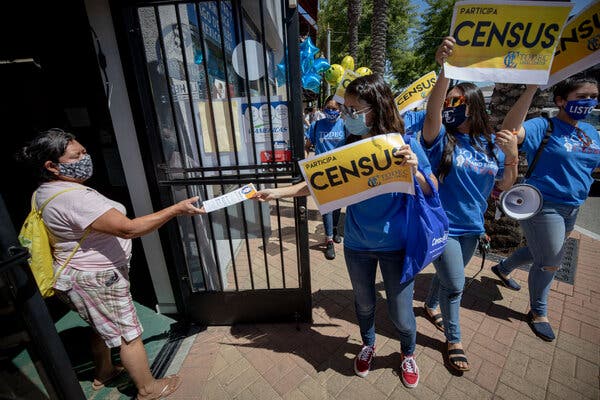
Volunteers handed out flyers in downtown Perris, a largely Latino community, where many people are wary of participating in the census. Credit…Christian Monterrosa for The New York Times

In some census tracts in far-flung areas of Riverside County, the response rate is hovering between 40 and 50 percent, about 10 percentage points behind the response rate a decade ago.

Even before the coronavirus hit, the census faced extraordinary challenges.

The Constitution requires a count of all residents, regardless of nationality or immigration status. California is home to almost 11 million immigrants, including about two million who are undocumented.

But President Trump pushed for 19 months, starting in 2018, to include a citizenship question on the decennial census, despite widespread criticism that it would dramatically depress responses, particularly from Latino immigrants. After the Supreme Court opposed the plan last year, Mr. Trump backed down.

Then last month he directed the government not to count undocumented immigrants for the purposes of reapportioning congressional seats. His policy memorandum would have the Census Bureau remove the immigrants from each state’s count using data estimates. While the move is being challenged in court, it has sown confusion anew in immigrant communities.

For many immigrants, documented and undocumented, his repeated insistence on not counting undocumented people has sent what seemed like a clear message: Your participation is not wanted.

Liz and Daniel Rivera, undocumented Mexicans who have lived in Riverside County for 18 years, were too nervous to fill out the 2010 census, they said. But this year, after attending workshops at TODEC, they were persuaded to fill out the form.

“We understood that it was safe and that it was important to participate if we want funding to improve our schools, parks and roads,” said Ms. Rivera, who said that she shared the information with friends and family.

But the couple delayed completing the online form after they, their two children and Ms. Rivera’s father, who is living with them, fell ill with Covid-19. While at home, they heard about Mr. Trump’s new presidential order to exclude undocumented immigrants from the count.

“We were so confused. We thought we weren’t supposed to participate anymore,” Ms. Rivera recalled.

She decided to call TODEC to inquire, just to be sure, and a staff member assured her that the Rivera household still had every right to take part. The couple plan to fill out the form next week.

Maria and Ramon Garcia, who have lived in the United States for two decades, said they had intended to complete the census until Mr. Trump’s recent announcement. Now they fear that participating could land them in the cross hairs of immigration enforcement.

“We were told that we should be counted,” said Mrs. Garcia, 50. “But then, just recently, we heard that the president doesn’t want us to be counted, and we’re worried that we could be deported if we participate.”

The Garcias called TODEC’s hotline on Friday to seek the legal center’s advice but could not be convinced that participating was safe.

“We came here from Mexico many years ago. We pay taxes, we work hard and we don’t want to put that in jeopardy,” said Mr. Garcia, 57, who has a gardening business with his wife. “I don’t think we should participate in the census.”

Adán Chávez, deputy director of the national census program at the National Association of Latino Elected and Appointed Officials Educational Fund, said that reaction was widespread.

“We have had to contend with challenge after challenge, attack after attack that threatens our census work,” he said.

The group has responded by intensifying its “¡Hagase Contar!” (“Be Counted”) campaign, working with Spanish-language television to promote participation and calls to a hotline that answers questions and helps people complete the census in Spanish.

“Our lift was already much heavier in the middle of a pandemic,” Mr. Chávez said. “Now we’re having to tell people that everyone gets counted, it’s your right. Don’t worry.”

According to an analysis of census data to be released next week by Mr. Ong’s team, the estimated median response rate for Hispanics nationwide was 50 percent by August, down by nearly 13 percentage points from 2010. Among non-Hispanic whites, the estimated response rate was 69 percent, compared with 71 percent a decade ago.

States with large undocumented populations — California, Texas, Florida, New York, New Jersey and Illinois — stand to lose the most from an undercount.

TODEC volunteers began last year to go door-to-door in hard-to-count neighborhoods, in the rural reaches of Riverside County, to educate immigrants about the census. They erected booths at health fairs and hosted information sessions to educate people about the census.

But like other groups working in the field, it was forced to shift strategy — to phone banking, social media and Zoom info sessions in March, when the coronavirus began coursing through California.

On a Zoom call last Thursday titled, “The Census and My Community,“ which was also streamed on Facebook, TODEC staff and a Census Bureau representative spent a full hour trying to motivate Latinos to participate.

“If we respond, our community will get money. But if we aren’t counted, it’s as if we don’t exist,” said Lupe Camacho, the bureau’s representative.

She appealed to their commonality as immigrants. “I’m from Mexico,” said Ms. Camacho, who spoke in Spanish throughout the session. “I’m a naturalized citizen. But citizenship has nothing to do with this.”

During the session, she described the census as “pure statistics,” “completely confidential” and “posing no danger,” all but pleading for participation.

“We don’t pass on any information about anyone — not to the DMV, not to ICE, not to any city, state or federal authority,” she said, referring to the department of motor vehicles and Immigration and Customs Enforcement.

In Perris, there were bright moments as well as cautionary ones.

Maria Estela Perez Gomez, 55, emerged from her beige house at the sight of the caravan. “We filled out our census form,” she said excitedly, doing a little dance as a Mexican band that was part of the parade and procession played.

The hurdles have also motivated some people.

Montserrat Gomez, a 19-year-old college student, said the decision to curtail the count was one reason she joined the group of young adults, mostly children of immigrants, who marched through downtown Perris on Friday waving signs and distributing fliers.

“We need to convince them that they need to be counted so that the community receives the political representation and financial resources that it deserves,” she said. “And now we have less time to do it.”

Source: In California, It Will Take More Than a Parade to Save an Imperiled Census

By Miriam Jordan

Photo Credit…Christian Monterrosa for The New York Times

Filed Under: immigration-news

Obama Forecasts How Biden Administration Will Enact Amnesty

August 8, 2020 by PERM News

On his website, former Vice President (and presumptive Democratic candidate for president) Joe Biden vows, if elected, to pass legislation “providing a roadmap to citizenship for nearly 11 million undocumented immigrants”. Last week, his old boss, former

President Barack Obama

, explained how Biden (or whoever controls him) will do it: by eliminating the filibuster.By way of background, and simply put, the filibuster (from the Dutch for “pirate”) is a way to block or delay the passage of legislation in the Senate. Under Senate rules, it requires a supermajority of 60 votes to end a filibuster and move to consideration of a bill.

To get more complicated, the practice comes from an 1806 rules change in the Upper Body (at the behest of then-Vice

President and President of the Senate Aaron Burr, best remembered as the man who killed Alexander Hamilton) that removed a provision (the “previous question motion”), which had allowed senators to pass a bill with a simple majority (still the rule in the House).

Senators may speak as long as they want on any issue, and if they refuse to yield, a vote on a bill cannot be taken until debate on the question is ended by means of a “cloture” vote (under Senate Rule 22).

Cloture is a more modern idea, promoted by then-President Woodrow Wilson in 1917, to bypass filibusters. It used to take two-thirds of the Senators “present and voting” to vote for cloture, but in 1975, that was reduced to “three-fifths of the Senators duly chosen and sworn” (60 of the current 100 senators).

The classic version of the filibuster is a major plot point in “Mr. Smith Goes to Washington“, the classic 1939 Frank Capra film starring Jimmy Stewart as the title character, Sen. Jefferson Smith. As IMDB describes the film: “A naive man is appointed to fill a vacancy in the United States Senate. His plans promptly collide with political corruption, but he doesn’t back down.” Plainly fiction.

The naïve Sen. Smith is made the patsy in a corrupt scheme, and false evidence is used to frame him. He takes to the Senate floor and speaks for hours in an attempt to block a vote to expel him, refusing to yield until he is overcome with exhaustion and faints. Sen. Joseph Paine (Claude Rains), overcome with guilt at his part in the plot, runs off to kill himself and then confesses on the floor. Justice prevails.


In its more modern (and mundane) iteration, as noted, a bill cannot be passed in the Senate until debate is ended, which again requires 60 senators to invoke cloture.

Speaking at the funeral service of former Rep. John Lewis (D-Ga.) on Thursday, Obama suggested that Lewis could be honored by passing a number of legislative proposals (which the former president not surprisingly supports). He continued: “And if all this takes eliminating the filibuster — another Jim Crow relic — in order to secure the God-given rights of every American, then that’s what we should do.”

With respect to the middle proposition in that sentence (the one separated by dashes), the Senate website notes: “Filibusters were particularly useful to southern senators who sought to block civil rights legislation, including anti-lynching legislation, until cloture was invoked after a 60-day filibuster against the Civil Rights Act of 1964.”

Twentieth century civil-rights legislation has a complex and somewhat surprising history. Then-Sen. John F. Kennedy (D-Mass.) voted against President Eisenhower’s Civil Rights Act of 1957 — the first since Reconstruction — which dealt with voting rights. Senate icons Sam Ervin (D-N.C.), Al Gore, Sr. (D-Tenn.), John Stennis (D-Miss.), James Fulbright (D-Ark.), Strom Thurmond (D-S.C.), and Barry Goldwater (R-Ariz.) all voted against the Civil Rights Act of 1964.

That bill passed with an overwhelming majority of Republican votes (just fewer than 82 percent of the 33 Republican senators voted in favor, as compared to just fewer than 69 percent of Democrats). The Senate website notes: “Republican Leader Everett Dirksen [R-Ill.] delivered the most significant speech in his career in support of civil rights legislation. Dirksen gained key votes for cloture from Republicans with a powerful speech calling racial integration ‘an idea whose time has come.'”

The filibuster, however, has not been limited in its use to civil rights legislation. Bernie Sanders (I-Vt.) launched an eight-and-a-half-hour filibuster in 2010 to block bipartisan tax legislation (described by NPR as “The Speech” that elevated Sanders’ “Progressive Profile”). Populist Sen. Huey Long’s (D-La.) filibuster of New Deal legislation in 1935 (to prevent his political opponents from obtaining positions in Franklin Roosevelt’s National Recovery Administration) included recipes for oysters and “potlikker”.

Despite modern floor-speech filibusters of the Bernie Sanders sort, such theatrics have largely been obviated by a change that then-Senate Majority Leader Mike Mansfield (D-Mont.) introduced in 1970: the two-track system, by which a filibustered bill can be set aside and the Senate can move on to other business, either with unanimous consent or with the agreement of the Minority Leader.

This, coupled with the aforementioned 1975 cloture change to “three-fifths of Senators duly chosen and sworn”, has led to what one observer has called the “faux-filibuster”, in which “a Senator at home in bed is a vote to continue the filibuster.” In other words, it takes 60 votes to get a bill moving in the Senate.

Among supporters of the filibuster in the past were Amy Klobuchar (D-Minn.) and (by my count) a bipartisan group of 59 other senators, who sent a letter to Senate Majority Leader Mitch McConnell (R-Ky.) in 2017, following the appointment of Neil Gorsuch to the Supreme Court.

And, as David Harsanyi noted in National Review, then-Sen. Barack Obama (D-Ill.), in 2005 argued in favor of it:

What they don’t expect is for one party — be it Republican or Democrat — to change the rules in the middle of the game so that they can make all the decisions while the other party is told to sit down and keep quiet. The American people want less partisanship in this town, but everyone in this chamber knows that if the majority chooses to end the filibuster — if they choose to change the rules and put an end to democratic debate – then the fighting and the bitterness and the gridlock will only get worse.

Of course, consistency in politics is a rare virtue (Obama himself filibustered the nomination of then-Judge Samuel Alito to the Supreme Court in 2006, an action he stated a decade later he regretted). But why would the former president change his mind now?

Simple: Obama believes that Biden will be elected, and that the Democrats will win a majority in the Senate in November, as the Wall Street Journal postulated on July 30. That will enable both to push for legislation that they want — like statehood for Puerto Rico and the District of Columbia. And amnesty for illegal aliens.

Each of these actions will solidify a Democratic majority into the foreseeable future, and give the party of Jackson the White House for as long.

Keep in mind that amnesty has come close to passage on more than one occasion in the recent past. The Comprehensive Immigration Reform Act of 2006 passed the Senate in May 2006 by a 62-36 margin, only to die in the then-Republican controlled House (which countered with the enforcement-heavy Border Protection, Antiterrorism, and Illegal Immigration Control Act of 2005, which passed the House 239-182).

The Border Security, Economic Opportunity, and Immigration Modernization Act (the “Gang of Eight” bill) passed the Democratic-controlled Senate in June 2013, only again to die in a Republican-controlled House.

Most significantly, the so-called DREAM Act was included in the Removal Clarification Act of 2010, which passed the Democratic-controlled House in a lame-duck session on December 8, 2010, 216-198. A cloture motion on the House amendment failed in the Senate on December 18, 2010, by a 55-41 vote (four senators did not vote), nine days after the DREAM Act of 2010 itself failed by one vote to gain the 60 votes needed in the Senate to proceed to debate.

If the Democrats maintain control of the House, win the White House, and gain control of the Senate and end the filibuster, amnesty would be among the first bills that would be rammed through to signature in the 117th Congress, for that most basic (and base) of reasons: power.

Assuming that there are 10.5 million illegal aliens in the United States (a conservative estimate the Pew Research Center in June 2019 made of the population in 2017), and depending on the parameters of the amnesty, that would mean that there could be that many new voters (or more) in 2026.

Most could be expected to vote Democratic. In a footnote in a separate Pew Research Center study in February 2020 (“Naturalized Citizens Make Up Record One-in-Ten U.S. Eligible Voters in 2020”), Pew noted that 53 percent of Hispanic immigrants who are eligible to vote identify with or lean toward the Democratic party, while 39 percent identify or lean toward the GOP. In 2012, Pew determined that 50 percent of “Asian Americans” identify with or lean toward the Democratic Party, while 28 percent were Republican.

The number of immigrant Hispanic Republicans seems high, given the fact that (again) Pew found that Hillary Clinton won 66 percent of the Hispanic vote in the 2016 election, as opposed to 28 percent for Donald Trump. That was actually lower than Obama’s share of the Hispanic vote in 2012 (71 percent to 27 percent for Romney) or 2008 (67 percent to 31 percent for McCain). The high-water mark for Republicans among this demographic was 40 percent (once more, Pew) in 2004, but that was an outlier.

Given the fact that DHS estimated in December 2018 that 70 percent of the illegal-alien population in the United States in 2015 (which it estimated at 11.96 million) was Hispanic (59 percent from Mexico, 6 percent from El Salvador, 5 percent from Guatemala, and 4 percent from Honduras), even Pew’s 14-point voting differential between Hispanic-immigrant Democrats and Republicans is huge.

There are more Salvadoran nationals illegally present in the United States (750,000) than there are residents of Alaska (735,720), the District of Columbia (711,571), Vermont (627,180), or Wyoming (572,381). And, more Mexican nationals here illegally (6,580,000) than residents in 32 U.S. states, Puerto Rico, and D.C.

In addition, there are large numbers of illegal aliens in swing states: 810,000 in Florida, 390,000 in North Carolina, and 380,000 in Arizona. Trump won Florida in 2016 by 119,770, North Carolina by 177,529, and Arizona by 84,904. Fourteen percent here and there starts to add up.

Nothing in Washington happens in a vacuum. Were the polls in favor of the president and Republicans in Congress, former President Obama likely would have stuck to his 2005 principles. Given that is not the case, the 2020 elections provide Dems an opportunity to change the rules, and thereby to change the electorate. All politics might be local, but it is usually self-serving, too.

Poor Jefferson Smith. As he said: “I wouldn’t give you two cents for all your fancy rules if, behind them, they didn’t have a little bit of plain, ordinary, everyday kindness and a little looking out for the other fella, too.” He can probably keep his money.

Source: Obama Forecasts How Biden Administration Will Enact Amnesty

Filed Under: immigration-news

« Previous Page
Next Page »
PERM Labor Certification Immigration Advertising New York, Los Angeles, Orange County, Miami Florida, New Jersey, San Francisco

Major Cards & Paypal Accepted

PERM RECRUITMENT AD PAYMENT OPTIONS

PERM AD QUOTE REQUEST FORM

  • SAVE TIME! Instead of entering ad text & details in our form, feel free to UPLOAD as many files as needed. For example PWD, etc.
    Drop files here or
    Accepted file types: doc, docx, txt, pdf, odt, xls, Max. file size: 2 GB, Max. files: 6.
    • EXAMPLE: Job Ttile + Job Duties + Education Requirements + Experience Requirements + Contact Name + Company Name + Address.
    • Company name is required.
    • (Of the worker being sponsored)
    • What's your Labor Certification role?
    • Your Quote will be sent here.
    • Please provide the address information for the job location, the Dept of Labor requires this to be in the ad, and the paper we (or your Attorney) advertise in will be selected based on this information.
    • MM slash DD slash YYYY
    • Due to many States adopting Wage Transparency Laws we highly recommend indicating the Salary or Wage Range in all ads.
    • This field is hidden when viewing the form
      MM slash DD slash YYYY
    • This field is for validation purposes and should be left unchanged.

    SWA JOB ORDER SERVICE

    https://www.youtube.com/watch?v=Q1r5tzmnCu4

    Blog Articles

    PERM ADS DOL FLAG SITE LABOR CERTIFICATION RECRUITMENT ADS

    FLAG.DOL.GOV: Essential Resource for PERM Labor Certification Recruitment Compliance

    March 18, 2025 By PERM Ads

    The Foreign Labor Application Gateway (FLAG) at https://flag.dol.gov/ serves as the Department of Labor's comprehensive digital portal for employers seeking to hire foreign workers through various … [Read More...] about FLAG.DOL.GOV: Essential Resource for PERM Labor Certification Recruitment Compliance

    CA GOV EMPLOYMENT DEVELOPMENT DEPT EDD

    SWA Job Order California: EDD Number FAQ

    March 25, 2021 By PERM Ads

    What is an EDD Number? An EDD Customer Account Number is the 10-digit state unemployment insurance identification number that the Employment Development Department of California assigns to a … [Read More...] about SWA Job Order California: EDD Number FAQ

    perm ads, immigration news, Green Cards

    The Green Card Process Through the Lens of a DMV Visit

    September 9, 2020 By PERM News

    As an immigration attorney, I try to provide clients with a basic, yet insightful, understanding of various aspects of a complex immigration system. It’s not always easy, but I often find analogies to … [Read More...] about The Green Card Process Through the Lens of a DMV Visit

    • Federal appeals court overturns ban against immigration arrests at Massachusetts courthouses
    • Trump Administration Seeks to Expand Biometric Data Collection for Immigrants
    • There Is No Route to the White House Without Latino Voters

    Copyright © 2025 · Dynamik-Gen on Genesis Framework · WordPress · Log in