Amid profound Covid-19 hospitalization spikes in border states that are universally blamed on lifted lock-downs, acting Customs and Border Protection Chief Mark Morgan confirmed yesterday that his agents are transporting some infected apprehended illegal migrants to U.S. hospitals, that probably many more are getting away into the interior, and that his agents are dying of the virus “in the line of duty”.
At a tele-press conference Thursday (August 6), Morgan offered that CBP had lost 10 personnel “in the line of duty because of Covid.” The acknowledgement of 10 fallen CBP personnel comes as two Border Patrol agents who died of the virus in the Del Rio, Texas, area have just been buried.
“If anyone’s showing signs or symptoms, we’re going to provide them that appropriate test. We’ll take them to the local healthcare provider, and we’ve done that,” Morgan said.
Morgan told national media that some among the sharply increasing numbers of apprehended migrants “know or highly suspect that they have Covid” and are hiring human smugglers to transport them over anyway, or climb the border wall on their own, or enter in other ways. Under emergency pandemic-control provisions of Title 42, the Border Patrol has returned 91 percent of Mexican citizens who are caught.
But in line with longstanding Border Patrol policy exemptions, Morgan acknowledged that agents are transporting those with Covid symptoms or who admit they have the virus to U.S. hospitals along the Mexican border. Those facilities have become so overrun with virus patients in recent weeks that they have been transporting patients by helicopter, fixed-wing aircraft, and ambulance fleets to hospitals throughout the interiors of California, Texas, and Arizona, where all blame typically is attributed only to the lifting of lock-downs and community spread.
Some of the illegal immigrants Border Patrol agents transport profess that they are ill with Covid while others are found with symptoms, injured from falling off the wall, or wandering lost and dehydrated and later test positive at the hospital, Morgan explained.
“We get to them right away,” Morgan said. “And we’re taking them directly to the hospital and once they get to the hospital then they’re being tested later and we find out they were Covid.”
Confirmation of CIS Reporting
Morgan said he wasn’t sure how many transported migrants turned out later to have tested positive, although he was aware of at least 60 reports that came back. (CBP may never learn of positive tests, a spokesman said.) But he also suggested that other numbers of infected illegal migrants (40,000 were apprehended in July) were using evasion tactics “for their own economic endeavors” and are presumed to be infecting large numbers of working illegal migrants they later join inside the United States.
“They’re running. They’re fighting. They’re doing everything that they can to avoid apprehension,” he said. “Even though some of the illegal aliens know, or highly suspect, that they have Covid … they’re still coming. They’re exposing everyone they come in contact with during their journey, as they illegally try to enter this country.”
In doing so, “They endanger the lives of CBP personnel and their families and those in our border communities and beyond. They don’t just remain in the border towns and cities. A single Covid illegal alien could infect hundreds of other illegal aliens as well as our workforce.”
Morgan’s comments provide the first official confirmation of a June 18 CIS post that reported on three anonymous Border Patrol agents who said the agency was transporting sick illegal immigrants to overcrowded area hospitals, rather than returning them to Mexico under Title 42, and also were becoming infected themselves. But the suggestion that infected migrant workers who evade Border Patrol are infecting interior migrant worker communities is new, if unconfirmed yet by tracing data.
Separately, in a July 19 interview with Breitbart Texas, Morgan confirmed reporting by CIS and others that a broader kaleidoscope of Covid patients legally fleeing across the border from collapsing Mexican hospitals also were responsible for part of the border-state hospitalization crisis, which state hospitalization data consistently shows is the nation’s most profound. Those legally crossing a supposedly closed border for Covid treatment include Mexican legal permanent residents, visa and border-crossing card holders, Mexicans with dual U.S. citizenship, and Americans living in Mexico. Current provisions of the March 20 border closure include an exemption for legal crossings for medical care.
Charges of Xenophobia and Racism Aside, Why All This Matters
At stake in understanding and acknowledging the extent of Mexico as an aggravating source of U.S. border-state hospitalizations is whether state and federal officials should consider policies beyond reinstituting U.S.-side lock-down and social distancing measures, and instead to consider changes to the federal March 20 border shutdown restrictions or to Border Patrol hospital transport policy in light of Title 42, or acting to relieve Mexico’s ongoing hospital capacity crisis, which is clearly bleeding over to the U.S. hospital system.
But U.S. and state officials rarely acknowledge the Mexico contribution or talk about it as Morgan did Thursday. That’s because, when they have, illegal immigration activists have excoriated them as xenophobic or racist, as happened to Arizona’s Republican Governor Doug Ducey when he cited Mexico as a significant source of Covid hospitalizations, and also when Trump administration officials discussed what to do about it privately.
As a result of such criticism, federal and state government officials have shied away from calculating the extent to which Mexico and the border shutdown policy are sources of the U.S. border-state hospitalization crisis, and reconfiguring public policies as necessary to counter it.
In mid-July, three members of Congress sent a letter to Chad Wolf, acting secretary of the Department of Homeland Security, requesting data that would indicate Mexico’s contribution to border hospitalizations, including how often the Border Patrol transports patients to hospitals. The information was due July 24 to Reps. Chip Roy (R-Texas), Paul Gosar (R-Ariz.), and Ted Budd (R-N.C.). Roy’s office said DHS had missed the deadlines but seemed to be gathering the information.
CIS has filed a Freedom of Information Act request and two Texas Public Information Act requests for similar information. All are pending.
Fallen Soldiers on the Covid Battlefield
Morgan’s remarks Thursday about Border Patrol transports of illegal immigrants to hospitals, and also that at least 10 CBP personnel have died of Covid in the line of duty, went unreported in the major media as of Friday morning.
But the deaths in the line of duty speak to an element of the nation’s tragedy with Covid-19 that may be lost to widespread failure of the media and public officials, fearful of social condemnation for saying it, to acknowledge the role of current border policy in this, too. Last month, in remarks that went largely unreported nationally, Morgan told a Senate subcommittee that illegal immigrants had exposed “several hundred” of his agents to Covid due to “high-risk contact”.
The names of the fallen are shrouded in silence. But local Texas media this week named two of the fallen agents:
Marco Gonzales, 49, died last month in a San Antonio hospital and was saluted and honored in a funeral procession of 50 vehicles that stopped in towns along the route to Del Rio, where he was buried Thursday.
Agustin Aguilar, another Border Patrol agent who worked in the Eagle Pass region and died of Covid, was buried in Del Rio the prior Saturday after another funeral procession where hundreds of people lined up to pay respects. Both agents were husbands and fathers.
The number of immigrants arrested at the southwestern border has more than doubled since the spring, fueled by Mexico’s economic slump and a Trump administration policy that migrants say works in their favor.
NOGALES, Mexico — Illegal migration along the southwest border of the United States has surged after a period of stagnation, as economic hardship, made worse by the pandemic, has driven thousands northward seeking work.
After plunging in the spring, when nations went into lockdown and shut down borders in an effort to curb the spread of the virus, the number of migrants arrested along the United States border with Mexico more than doubled between April and July, according to the U.S. government.
As the numbers rise, immigration is becoming once again a primary rallying cry for President Trump, who is trailing in the polls in his bid for re-election and looking for purchase with an electorate that is increasingly unhappy with his handling of the pandemic and the economy.
“Despite the dangers posed by Covid-19, illegal immigration — it continues,” Mark Morgan, the acting commissioner of Customs and Border Protection, said on Thursday.
Undocumented migrants were “putting American lives at risk,” he added, although the United States leads the world in the number of deaths from the coronavirus.
Mr. Morgan touted the necessity of continuing to build the border wall, a project central to Mr. Trump’s political identity, to forestall illegal migration and the further spread of the coronavirus by infected undocumented immigrants.
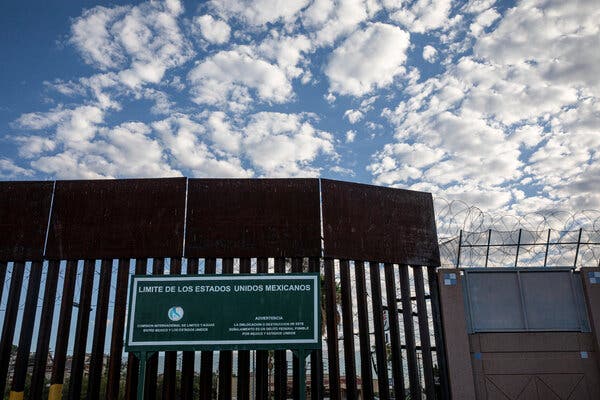
The Mexico side of the border wall in Nogales. In remote areas, far from cities, the wall becomes a fence, or sometimes no barrier at all. Photo Credit : Adriana Zehbrauskas for The New York Times
The numbers are still far below the peak of the migration crisis in 2019, and also far lower than the record highs set in the 1980s, 1990s and 2000s, when annual tallies of migrants apprehended at the southwest border often topped 1,000,000.
And while undocumented migration is rebounding from a brief lull, who is coming — and why — has changed significantly since the pandemic. Many say they have been inspired to try to migrate now because of a new Trump administration policy that returns them to Mexico quickly, often within hours of being captured, but has the unintended effect of giving them more chances to cross the border illegally.
During the past several years, Central Americans dominated the flow of migrants trying to cross the southwest border, with many seeking asylum. They often traveled as families, frequently with children, and peacefully surrendered to American border agents in the hope of getting a chance to apply for sanctuary.
Now, many Central Americans who might otherwise have sought to migrate have been discouraged from leaving home by closed borders and other pandemic-related travel restrictions, migrants’ advocates said. And word has gotten back to potential refugees fleeing persecution that under the Trump administration’s restrictive immigration policies, there is little chance now of securing asylum in the United States.
Instead, the vast majority of those caught trying to cross into the United States in recent months are Mexican, officials and migrants’ advocates said. And their encounters with the authorities were often chaotic, with migrants scattering into the desert to evade capture.
“They’re running, they’re fighting,” Mr. Morgan said. “They absolutely have no appreciation for the deadly consequences of their actions while we’re navigating a global, deadly pandemic.”
Mexico has been among the countries worst affected by the coronavirus pandemic, with nearly 49,000 reported dead — behind only much larger Brazil and the United States. The real number of lives lost is believed to be much higher because of a dearth of testing and a significant undercount of cases.
Millions lost their jobs amid a mounting recession that economists expect to be the deepest in nearly a century, but the government has eschewed the stimulus measures that other nations used to prop up economies as they buckled under the weight of the pandemic.
In July, 78 percent of those apprehended on the southwestern border were from Mexico, mainly single adult men, Mr. Morgan said.
The number of migrants detained along the border with Mexico jumped to 38,347 in July from 16,162 in April, a 137 percent increase, according to U.S. Customs and Border Protection.
That is still a far cry from last year, when there were more than 99,000 apprehensions in April of 2019 and nearly 133,000 that May. But the steep rise in recent months reflects a resurgence of the migratory stream.
While migrants and their advocates say that job losses and deepening poverty have been principal drivers of the recent increase from Mexico, a recent Trump administration border policy has also been inspiring migrants to try their luck now.
In March, the administration issued an order that allowed American immigration agents to suspend normal procedures and swiftly expel illegal border crossers, often in a matter of hours, citing the public health need to keep detention centers as empty as possible and prevent the spread of the coronavirus. The new policy also extended to refugees seeking asylum.
For about 91 percent of those arrests in July, the administration used the special rule to rapidly return a migrant to Mexico.
Numerous migrants interviewed in this border city in recent days said the policy had been an incentive for them: If they failed in their bid to enter the United States, they said, they would be spared the hardship of detention and would be quickly sent back to Mexico, putting them in position to try again.
“What’s encouraging us now is that because of the pandemic, they are letting us go quickly,” said Jacobo, 27, a carpenter from the Mexican port city of Veracruz who tried, unsuccessfully, to cross the border at Nogales late last month.
He requested partial anonymity to avoid drawing attention from the American and Mexican authorities.
Migrants say that along this stretch of the border, it is easy to find a smuggler to show you the way across. Most crossings occur outside the cities and towns, in remote areas where the towering metal border barrier gives way to low wire fencing, in some places, or nothing at all.
But it is also a fiercely unforgiving environment: Migration routes wend through a vast wilderness desert region in southern Arizona that puts migrants at great risk of dehydration, heatstroke and starvation. Thousands of travelers have died in recent decades trying to cross.
Jacobo, who decided to migrate after the pandemic cost him his job at a construction firm, tried to cross one night late last month in the company of four other migrants, guided by a smuggler who communicated with them by cellphone.
He had already paid about $450 to the criminal group that controlled the smuggling routes along that stretch of the border, and promised to pay another $6,700 to the smuggler if he successfully made it into the interior of the United States.
Somewhere outside the small Mexican border town of Sásabe, Jacobo and the four others crawled under a low wire fence that demarcated the border. For two days, they trudged north across the Arizona desert, moving mostly at night and during the cooler morning hours, and resting when daytime temperatures became severe.
Late on the second night, they were intercepted by American border agents. The migrants fled. But over the next five hours they were all rounded up, then marched back to Nogales and handed over to Mexican immigration officials, who processed and released them.
That evening, Jacobo rested at the San Juan Bosco migrant shelter in Nogales, and waited for his brother, an undocumented immigrant living in the United States, to send him money for another attempt. He was going to keep trying until he was successful, he said; giving up would be foolish.
“The possibilities of entering are good,” he said, adding that the quick processing at the border was “in our favor.”
The shelter’s population reflected the recent shifts in the migratory flow. Last year, during the peak of the migration crisis, as many as 200 migrants slept there a night, most hoping to present themselves at the border and apply for asylum, said Gilda Irene Esquer Félix, who runs the shelter.
But since the Trump administration had effectively suspended access to the asylum program, nearly all of those migrants who had been waiting for an opportunity to cross had left the shelter, returning to their home countries, melting into Mexican society or trying to find an illegal route across the border.
In recent months, only a handful of migrants have been showing up at the shelter each day, Ms. Esquer said, with most being failed border crossers who needed a place to rest for a night or two after being caught in the United States and sent back to Mexico.
Two Mexican women traveling together were among about a dozen residents there one night last week. They had met during a failed crossing several weeks ago and had since tried three other times, to no avail.
“Various friends have been successful,” lamented Dinora, 24, who allowed publication of only her first name. She had been compelled to migrate, she said, after she lost her job as a seamstress in a factory in her home state of Campeche on the Gulf of Mexico.
She had heard that the Americans were not detaining people, making it much easier to try again. But after four failed crossings, and the duress of trying to cross the desert, she had decided to head back home.
Cover Photo: Men who had been returned to Nogales, Mexico, after trying to cross the border. They were part of an increase in the number of migrants trying to cross the southwest border. Credit…Adriana Zehbrauskas for The New York Times
On July 22, 2020 a group of foreign nationals filed a class action lawsuit against the U.S. Citizenship and Immigration Services (USCIS) based on delays in the issuance of employment authorization documents (EADs) following the approval of applications for employment authorization (form I-765).On August 3rd, the federal district judge overseeing the case handed the plaintiffs a victory, ordering the USCIS to issue the EADs within seven days.
The USCIS previously contracted with a third-party company to produce EADs and green cards. The USCIS planned to have federal employees take over the printing to cut costs, but in the interim, approximately 75,000 EADs have not been physically produced. This has resulted in many foreign nationals losing work authorization, as the I-765 approval does not grant work authorization without the physical EAD.
Lawsuit Does Not Help Those With Pending I-765s
It should be noted that this lawsuit only applies if a person has an I-765 that has been approved, but no EAD has yet been issued. Unfortunately, this lawsuit does not provide any relief to applicants with pending I-765 applications.
Conclusion
While this is good news for those awaiting EADs to be produced, an injunction hearing is set for August 10, 2020. The USCIS argues that there is no statute or regulation setting a timeline for action, while the judge responds that in the absence of a timeline in statute or regulation, the court retains jurisdiction to decide whether the delay was reasonable. The delay is an immediate threat of harm as individuals cannot provide for themselves and their families.
United States Citizenship and Immigration Services
(USCIS) has requested over $1.2 billion in funding from Congress to support its operations beyond August 31, 2020. As immigration attorneys, we know how critically important the agency is to families and businesses across the nation because without USCIS adjudicating cases, families cannot reunite and businesses’ ability to retain talent is uncertain. However, before Congress gives USCIS any financial support, guardrails need to be put up to ensure data is shared and the agency doesn’t drive itself into the ground again.
United States Citizenship and Immigration Services
(USCIS) has requested over $1.2 billion in funding from Congress to support its operations beyond August 31, 2020. As immigration attorneys, we know how critically important the agency is to families and businesses across the nation because without USCIS adjudicating cases, families cannot reunite and businesses’ ability to retain talent is uncertain.
However, before Congress gives USCIS any financial support, guardrails need to be put up to ensure data is shared and the agency doesn’t drive itself into the ground again.
First, it is important that USCIS provide more specific data regarding the total number of applications received since March of this year and the exact amount of funds spent on vetting, by USCIS and diverted to other enforcement agencies.
The decrease in application numbers alleged by USCIS seems surprisingly steep. The management of USCIS over the last three years has eroded trust to an extent that its ability to accurately portray the scope of the problem it faces is hard to believe. And if USCIS can’t clearly and accurately describe the scope of the problem, how will it understand the causes of this problem, or the remedy?
The justification provided for the bailout request is the impact of COVID-19. The pandemic has reportedly caused an alarming drop in application numbers, whose filing fees support USCIS operations.
In the initial demand to Congress, made in May, USCIS Deputy Director for Policy, Joseph Edlow, described an “an alarming drop in applications at the end of March” and warned of a “crippling budget shortfall.” He proceeded to indicate that, as a result of COVID-19, USCIS had seen “a 50% drop in receipts and incoming fees starting in March” and predicted that “application and petition receipts will stay well below plan through the end of Fiscal Year 2020.”
Acting Secretary of the Department of Homeland Security, Chad Wolf, sent a supporting letter in which he remarked that “USCIS is in dire need of a one-time infusion of funding to ensure their operations continue past August 3, 2020” and that “USCIS’ annual Immigration Examinations Fee Account fee collections have not met their historical forecasted projections due to the COVID-19 pandemic.” The sentiments of Mr. Wolf were echoed by Russell T. Vought, Acting Director of the Office of Management and Budget, who also sent a supporting letter outlining that USCIS had experienced “a 51 percent year-over-year decline in receipts” when compared with 2019, for “a two-week period in March/April 2020.”
The time period referenced by Mr. Vought will ring a bell with most attorneys who practice employment-based immigration law. At the very beginning of April each year, U.S. petitioners file hundreds of thousands of H-1B cap petitions with USCIS. Of these, at least 85,000 are randomly selected for processing in a lottery, and receipted by USCIS.
Therefore, USCIS receives a significant spike in applications and fees at the beginning of April each year, and did so in 2019. However, the H-1B cap process changed this year. In 2020, for the first time, the lottery took place in March using a registration system. H-1B cap applications could then be filed for the selected registrants at any time in April, May, or June.
Accordingly, a significant discrepancy between the number of applications received at the beginning of April 2020, and the number received at the beginning of April 2019, could be explained by this new process – and may be balanced out by the additional H-1B cap filings through the remainder of April, May, and June.
Certain developments over the last few years also call into question whether such a sudden, significant and sustained decrease in filings is likely. Under Matter of Simeio Solutions, LLC (2015), a change in the worksite to a new metropolitan statistical area requires the filing of an H-1B amendment.
Accordingly, employers will have been required to file many such amendments recently to ensure their H-1B employees, now working from home due to the pandemic, remain compliant. This should have resulted in an increase in filing.
Furthermore, over the last three years persistent immigrant visa backlogs have crept into the EB-1 preference category for individuals born in India and China. This requires employers to file additional H-1B extensions while their employees await until their priority date becomes current.
Unlike H-1B status, L status cannot be extended while a foreign national waits for a green card. There has been a corresponding increase in petitions being filed for individuals seeking a change from L-1A to H-1B, so that they can remain in the U.S. until their EB-1C priority date becomes current.
Additionally, the 2018 Notice to Appear Policy Memorandum, which threatens the issuance of a Notice to Appear in immigration court immediately upon denial of an I-485, has served as a stimulus for the filing of additional applications to ensure foreign nationals maintain their nonimmigrant status until the adjudication of their I-485, even though this is not required. Not to mention the public charge rule, since enjoined, which resulted in a spike in Adjustment of Status filings before October, and again in February before the new rule took effect.
It should also be added that the COVID-19 pandemic has required a number of different groups file applications with USCIS who would not otherwise have done so. This includes, for example, individuals in a non-immigrant status who were planning to leave the U.S. but are now unable or unwilling to do so. Such individuals must file applications with USCIS to remain lawfully inside the country.
Furthermore, a number of nonimmigrant visa categories allow applications to be filed either with USCIS or at an embassy, consulate, or border crossing (for example – TN, E-3, and blanket L petitions). Due to border closures and the risks of travel, these applications must now be filed with USCIS.
In his letter to Congress, Russell T. Vought states that “USCIS continues to analyze available data to refine revenue and spending projections.” For the reasons outlined above, it is imperative that USCIS release this new data as it becomes available.
A substantial drop in applications is not implausible, and USCIS workers and their families should certainly not be held hostage to political maneuvering, but a grant of $1.2 billion cannot be justified through snippets of information and fragments of statistics, especially as now reports are surfacing that the agency may end up with a surplus and furloughs are delayed til at least August 31. There is just not enough good information.
It is welcome news that the House Judiciary Committee will ask tough questions on Wednesday, July 29, 2020 of the agency and hear from witnesses and stakeholders, but this is not enough. We need good information, and at the very least, USCIS should provide a comparison of total applications received in April, May, and June between last year and the current year.
The federal court ruled that the Trump administration’s so-called public charge rule for green card applicants could not go into effect in New York, Connecticut and Vermont
WASHINGTON — A federal appeals court on Tuesday blocked the Trump administration’s efforts to deny permanent residency to legal immigrants who make even limited use of public benefits like Medicaid, food stamps or housing vouchers, but restricted the injunction to New York, Connecticut and Vermont.
The 114-page ruling by the U.S. Court of Appeals for the Second Circuit affirmed a decision last week by Judge George B. Daniels of the U.S. District Court in Manhattan, who said the wealth test could discourage residents from seeking medical care during the coronavirus pandemic. The so-called public charge rule that was introduced last year expanded the number of federal support programs whose enrollment would disqualify applicants from green cards.
Immigration groups have argued that the rule, even before it took effect, had discouraged immigrants in the country legally from seeking medical treatment or financial support.
In the past, only substantial and sustained monetary help or long-term institutionalization counted against immigrants applying for green cards, and fewer than 1 percent of applicants were disqualified on public-charge grounds.
Department of Homeland Security officials have criticized the issuance of nationwide injunctions by district judges, and the three-judge panel of the appeals court indicated it shared the concern that the lower court’s nationwide block would be “imposing its view of the law within the geographic jurisdiction of courts that have reached contrary conclusions.”
The judges also noted that the rule had been the subject of multiple legal challenges, including one that has reached the Supreme Court. The court ruled in January that the Trump administration could move forward with the rule as the court system heard substantive arguments for and against it. At that time, Justices Neil M. Gorsuch and Clarence Thomas issued a concurring opinion saying that such nationwide blocks caused “chaos for litigants, the government, courts and all those affected by these conflicting decisions.”
The states covered by the new injunction are within the federal appeals court’s jurisdiction.
“We see no need for a broader injunction at this point, particularly in light of the somewhat unusual posture of this case, namely that the preliminary injunction has already been stayed by the Supreme Court,” wrote Judge Gerard E. Lynch, who was appointed by President Barack Obama.
The plaintiffs in one of the two lawsuits considered by the court included New York City, Connecticut and Vermont. Immigrant rights groups brought the second case.
The Department of Homeland Security did not immediately respond to requests for comment.
Department officials have argued that the wealth test would prevent the admission of immigrants who would not be able to support themselves in the United States. After announcing the policy, Kenneth T. Cuccinelli, the department’s acting deputy secretary and a defendant in the case, promoted the rule by revising the iconic sonnet on the Statue of Liberty by saying the United States would welcome those “who can stand on their own two feet.”
He added that the verses, written by Emma Lazarus, referred to “people coming from Europe where they had class-based societies.”
In his ruling, Judge Lynch challenged the argument from homeland security officials.
“D.H.S. goes too far in assuming that all those who participate in noncash benefits programs would be otherwise unable to meet their needs and that they can thus be categorically considered ‘public charged,’” Judge Lynch wrote.
Kenneth T. Cuccinelli, the acting deputy homeland security secretary, has promoted the public charge rule.Credit…T.J. Kirkpatrick for The New York Times
The United States Border Patrol raided a humanitarian aid camp in Arizona on July 31, detaining volunteers and over 30 people receiving care.
The camp—known as Byrd Camp—is run by No More Deaths (NMD), an organization that works to end the death and suffering of people crossing the U.S.-Mexico border. The raid follows a pattern of retaliation against humanitarian aid and criticism of the Border Patrol.
The Border Patrol’s Raid
As the sun set, an armored vehicle, three ATVS, two helicopters, and at least 24 marked and unmarked vehicles descended on Byrd camp in over 100-degree weather. The camp has provided humanitarian aid in the Sonoran Desert near Arivaca, Arizona since 2004.
The raid included the Border Patrol Tactical Unit (BORTAC), the agency’s SWAT-style team. This is the same team that recently cracked down on protesters in American cities. Agents chased and arrested undocumented individuals who had been receiving medical care and other aid at the camp.
Unmasked agents shouted and pointed rifles at volunteers, whose hands had already been zip tied behind their backs. The agents cut open and ransacked tents, searched vehicles, and disconnected power from the well.
A warrant, which agents refused to show at the beginning of the raid, targeted documents and electronic devices. They confiscated camp medical documents and phones, preventing volunteers from documenting the event. A Border Patrol cameraman, however, filmed the event.
Border Patrol also brought a cameraman. He filmed the scene as agents chased and arrested people who had sought out humanitarian aid and respite from the 100 degree heat.
The day before the raid, Border Patrol agents entered the camp without a warrant and detained one undocumented woman. From that time on, agents kept the camp surrounded. They required volunteers to pass through checkpoints to enter and exit.
Border Patrol’s History of Retaliation Against Humanitarian Aid Workers
This recent raid continues a history of retaliation against No More Deaths. In 2017, agents raided Byrd Camp, violating a written agreement from 2013 between the organization and the Tucson Sector Border Patrol for the first time. That agreement recognizes the camp as a medical facility as defined by the International Red Cross. Those facilities are off-limits for government interference.
Border Patrol and BORTAC arrested people receiving care and ransacked the humanitarian aid station, ripping apart tents and destroying medical supplies. pic.twitter.com/jb5Ov4RwVJ
In 2018, NMD published a report on Border Patrol’s interference with humanitarian aid. The organization asked advocates to call the Tucson Border Patrol Station with their criticism. Hours later, agents raided Byrd camp again. This time, they arrested volunteer Scott Warren and two undocumented men.
In 2017 and 2018, the federal government brought charges against a total of nine NMD volunteers related to their humanitarian aid work. The only convictions (for entering a wildlife refuge without a permit and abandoning property (e.g., water and food)) have since been reversed.
Two days before the recent raid, NMD had released evidence related to the 2017 raid obtained through a Freedom of Information Act request. The documents showed that BORTAC had advised on the raid, and that a leader of the Border Patrol union pressured agents to proceed quickly without a warrant.
“Items” to be seized included human beings. Think about that for a second. https://t.co/bGFyqJZzSA
Greg Kuyendall, an attorney who represented Scott Warren, responded to the recent display of enforcement stating:
“…Humanitarian aid camps are recognized as a basic good and a thing that needs to be provided, normally by either NGOs or governments themselves, and they’re absolutely off-limits from law enforcement. That’s well-established in the International Red Cross guidelines, as well as the United Nations’ guidelines…Every organization that deals with refugees and people that are in crisis situations, whether they’re manmade or not, understands that humanitarian aid stations cannot be places where law enforcement is allowed to go hunting.”
There was no need for the Border Patrol to raid Byrd Camp, especially using paramilitary force during a pandemic. Such actions serve only to retaliate against human rights organizations and intimidate citizens from providing humanitarian aid. No More Deaths’ aid work should be decriminalized and protected.
This “Immigration Nation,” a documentary by Christina Clusiau and Shaul Schwarz, gives a glimpse of the tactics used by Immigration and Customs Enforcement agents.Credit…Netflix
If you watch only one documentary about immigration, then by all means make it “Immigration Nation,” a six-hour Netflix series that mixes reporting with an impressive amount of vivid ride-along observation.
Parts of it may start to drag or feel padded, but its see-the-whole-elephant approach to one of America’s most divisive issues has inherent value. It will almost certainly leave you better informed than you were before, even if its net effect may be to further entrench people on whichever side of the debate they already occupy.
Immigration to the United States is a story spread across thousands of miles, a variety of faceless government agencies and a tapestry of determined, often desperate petitioners, and “Immigration Nation” tries to cover as many of its facets as it can cram in. This includes the widely known ones, like child separation at the border, as well as less familiar angles, such as the exploitation of migrants who take on the work of natural-disaster recovery and federal attempts to co-opt local law enforcement into immigration agencies.
Much of the time, especially after its more fluid and immersive initial episodes, the series takes a standard television current-affairs approach, and as you watch its segments you may recall sharper or more evocative reports on the same stories by shows like “Frontline,” “Vice” and “Last Week Tonight With John Oliver.”
But the makers of “Immigration Nation,” Christina Clusiau and Shaul Schwarz, benefited from time — they filmed for nearly three years — and a startling degree of access, particularly to agents of Immigration and Customs Enforcement as they rounded up immigrants, processed them for (mostly) deportation and spoke to the camera about how it made them feel. And in the series’ first two hours, the results of that embedding, with ICE operations in New York, Charlotte, N.C., and El Paso can be startling and engrossing.
Part of that effect comes from seeing agents push the boundaries of legality — most strikingly, how they routinely enter apartments when “invited” by cowed, uncomprehending immigrants, in a way that’s surprisingly similar to what you’d see in a TV cop drama. (Maybe that’s where they learned it.) Once inside the home of the target, probably an immigrant accused of a crime, they frequently find “collaterals,” additional people who can be rounded up simply because they’re undocumented.
Material like that, and worse — like an agent picking an apartment building’s lock — gained “Immigration Nation” some prerelease publicity, particularly when The New York Times reported that ICE had pressured the filmmakers to delay the release and remove footage.
But the real impact of the show’s early episodes isn’t the outrage you may feel over the thuggish tactics. It’s the wearying, demoralizing depiction of a self-perpetuating bureaucracy, one that churns through the lives of people it takes little notice of — as if your trip to the D.M.V. meant not just standing in an endless line, but then being shackled and put on a plane to Central America.
The scenes inside field offices and detention centers, as agents bluffly banter with the people whose lives they’re destroying and then joke with one another about funny accents and kung pao chicken, might have been written by Kafka, except his dialogue would have been better. The series’ hallmark is not an image but a sound bite — the agents’ endless variations on “I may not like it, but it’s the job.” The human-rights lawyer Becca Heller sums it up nicely: “When you add up all the people just doing their job, it becomes this crazy, terrorizing system.”
“Immigration Nation” provides abundant evidence for things that some might call fake news, like the determination of ICE, under the Trump administration, to remove immigrants from the United States in bulk regardless of whether they pose any danger. As one of the disarmingly honest agents says, “They want to get rid of everybody, I guess.”
That will be the takeaway for those who want to make political points from the series, from either direction. And in the later episodes there are wrenching individual stories, like that of a Guatemalan grandmother seeking asylum and sitting for more than a year in a Texas detention center, though these segments tend to indulge in superfluous scenes of inspiration and tearful condolence.
But what sticks with you from “Immigration Nation” is its up-close depiction of the banality of deportation — of the huge disconnect between the everyday people of ICE and the Border Patrol and the everyday people they detain, arrest and “process.” (In El Paso, a morning meeting at a detention center ends with the chant, “1, 2, 3, processing!”)
Agent after agent expresses an ambivalence about the job that’s given its most extreme expression by an Arizona ICE investigator who says, “I put my personal feelings aside, which, yeah, maybe that’s what every Nazi said, right?” But he immediately adds, “I actually believe in the cause of trying to enforce some sort of sovereignty over our borders, and no one’s figured out a better way to do it yet.”
It’s a nice summation of the schism, within the country at large, that will keep us talking past one another despite the filmmakers’ best efforts.
The Supreme Court on Friday turned down a plea from opponents of President Donald Trump’s border wall to order a temporary stop to construction. By a vote of 5-4, the justices declined to lift a stay, entered just over a year ago, that allowed the federal government to continue to spend federal funds on construction while a legal challenge to the wall continues. The challengers had urged the Supreme Court to intervene last week, telling the justices that if the stay were not lifted, the Trump administration could finish the wall before the court even decides whether to take up the case on the merits.
The brief one-sentence order was the latest in the dispute over the wall on the U.S.-Mexico border. The clash came to the court for the first time last year, after a federal district judge in California agreed with the challengers, the Sierra Club and the Southern Borders Communities Coalition, that government officials did not have the power to spend more than Congress had already allocated for border security. U.S. District Judge Haywood Gilliam barred the government from using $2.5 billion in funds originally earmarked for military-personnel funds to build the border wall, and the U.S. Court of Appeals for the 9th Circuit declined to stay that ruling while the government appealed. The Trump administration then went to the Supreme Court, which – by a vote of 5-4 last July — put Gilliam’s order on hold and allowed the government to use the Pentagon funds on the wall.
After the 9th Circuit upheld Gilliam’s decision last month, the challengers asked the Supreme Court to step in and lift the stay. Otherwise, they contended, the government would be able to finish the parts of the wall that are the subject of their challenge before the litigation concludes.
The Trump administration urged the court to leave its year-old stay in place. When the justices rejected the challengers’ arguments last year, U.S. Solicitor General Jeffrey Wall posited, they were “presumably aware that the result would be construction during litigation.” And in any event, Wall added, the government plans to file its cert petition seeking review of the 9th Circuit’s decision on Aug. 7, which would allow the justices to consider it at their first conference after the summer recess.
Justice Stephen Breyer filed a short dissent from the court’s denial of the challengers’ motion to lift the stay, which was joined by Justices Ruth Bader Ginsburg (who, the Court’s Public Information Office reported, was discharged from the hospital today after undergoing a non-surgical procedure earlier this week), Sonia Sotomayor and Elena Kagan. Breyer reiterated that when the court granted the stay last year, he had suggested a middle ground that, he said, would avoid irreparable harm on both sides of the dispute: Put Gilliam’s order on hold as far as it prevented the government from finalizing the contracts for the construction of the wall, but continue to bar the government from actually spending the Pentagon funds or beginning construction. “Now,” Breyer observed, the government “has apparently finalized its contracts, avoiding the irreparable harm” that it said justified the stay last year. Because Friday’s order allowing construction to continue may effectively serve as a final judgment in the case, Breyer explained, he would have lifted the stay of Gilliam’s order.
In a statement issued shortly after Friday’s order, an attorney representing the challengers emphasized that the justices’ “temporary order does not decide the case.” Dror Ladin, a staff attorney for the American Civil Liberties Union, stressed that the Trump administration “has admitted that the wall can be taken down if we ultimately prevail, and we will hold them to their word and seek the removal of every mile of unlawful wall built.”
A group of voters from several states filed a lawsuit in US federal court Friday to halt enforcement of a presidential memorandum that would alter the census count by leaving out undocumented immigrants.
The US Constitution mandates that a census be carried out every ten years, while section 2 of the Fourteenth Amendment requires “counting the whole number of persons in each state, excluding Indians not taxed.” Courts, including the Supreme Court, have traditionally interpreted the word “persons” to include non-citizens regardless of their immigration status. The July 21 memorandum would make it government policy “to exclude from the apportionment base aliens who are not in a lawful immigration status.”
The number of a state’s representatives in the House of Representatives depends on the population of the state, and not counting undocumented immigrants will radically alter state population totals and therefore the number of representatives each state has in the House.
Voters from California, Nevada, New York, Florida, and Texas, with the support of the National Redistricting Foundation, filed suit in the District Court of Maryland, alleging that the president’s memorandum is part of an “ongoing discriminatory scheme to dilute the voting power of non-whites, Hispanics, and immigrants of color, and to shift political power to non-Hispanic whites.” They claim they will be harmed by the exclusion of undocumented citizens from the census, because the resulting reapportionment of representatives will cause them to lose political representation and lead to an “under-allocation of federal funding to Plaintiffs’ communities.”
Plaintiffs are asking the court to find the president’s memorandum unconstitutional, and they seek to permanently enjoin the president and his administration from taking any action that would limit or exclude the counting of undocumented immigrants in the census.
U.S. Citizenship and Immigration Services (USCIS) published a final rule on July 31 that will impose significant fee increases across many facets of the legal immigration system.These changes include an astronomical 80% increase to the cost of becoming a U.S. citizen and a first-time fee for asylum applicants.
With this new rule, the Trump administration demands that immigrants, vulnerable individuals, and American businesses take the brunt of USCIS’ financial mismanagement. This could make the legal immigration system inaccessible to millions of people.
These applications will have increased fees starting on October 2:
Green Card Applications
USCIS is “debundling” several forms in the green card application process.
Applicants previously paid one fee for all the forms but will now have to pay for each form separately, including a request for work authorization and travel documents that are filed so that people can work and travel while their application is being processed. In total, the agency will charge an extra $1,150 to apply for a green card and those other documents. That brings the cost from $1,760 to $2,910.
Naturalization Applications
The financial burden of becoming a U.S. citizen is now especially high—USCIS increased the total cost of a naturalization application by over 80%.
Online naturalization applications will now run $1,170, up from the previous price of $640. USCIS says the new fee will cover the full cost to process the application as well as some overhead costs.
USCIS is also eliminating almost all fee waivers that it previously provided for low-income immigrants seeking citizenship. Once the rule goes into effect, everyone will have to pay the full fee with few exceptions. Given that almost 40% of Americans don’t even have $400 in the bank, requiring everyone who wants to become a citizen to pay $1,170 will put citizenship out of reach for many.
H-1B Visa Applications
The Trump administration has attacked the H-1B visa category for years, and this new rule is no exception.
This temporary nonimmigrant visa category allows U.S. employers to petition for highly educated foreign professionals to work in “specialty occupations” that require an advanced degree.
Filing fees for employers petitioning for an H-1B worker will increase by 70%. The cost to petition for one worker will total over $3,000. But higher fees will not equal greater service. The agency is also increasing the time it takes to process H-1B visas. Employers who pay for “premium processing” of their petitions will now have to wait almost twice as long to receive a decision.
The fee hike is especially ill-timed given the pandemic. Most people with H-1B visas fill critical vacancies in the science, technology, engineering, and math fields.
Asylum Applications
USCIS will now charge a $50 fee to apply for asylum. This will be the first time the United States has charged a fee since WWII. This makes the United States only the fourth country in the world to charge a fee for asylum applications. Iran, Fiji, and Australia also charge a fee.
The new fee for asylum applications is particularly devastating as people who are fleeing their countries in search of safety often do so with limited resources. There is a strong chance that individuals who would have otherwise qualified for asylum will now be unable to even apply. USCIS also refused to provide any fee waivers for this expense.
In addition, asylum seekers will also now be required to pay a fee for a work permit for the first time, so long as their asylum application is still pending. The cost will be $550. But that too may be out of reach for many. Asylum seekers are not allowed to work before getting a work permit. And if they do work without authorization, under newly proposed asylum rules they could disqualified from asylum if they fail to report even a penny of that income on their taxes.
DACA
The agency also walked back its original plan to increase the fee for Deferred Action for Childhood Arrivals (DACA) applications, as a new DACA memorandum signed by Acting Secretary Wolf called for freezing fees.
DACA holders will, however, now have to renew their status every year instead of every other year, so the fees that they pay will be doubled through other means.
USCIS’ History of Financial Issues
These fee hikes, along with others not mentioned above, come as USCIS faces an enormous budget shortfall and impending furloughs of two-thirds of its staff. USCIS requested a $1.2 billion bailout from Congress this summer. The agency claims that the COVID-19 pandemic and subsequent office closures wiped out most of the fee-based agency’s revenue.
But USCIS has long suffered from fiscal mismanagement. In reality, the fee hikes represent the culmination of years’ worth of financial recklessness and poor policy changes. These issues have only been exacerbated by the pandemic. The published rule, however, says the agency did not take COVID-19 into consideration when determining the new fees.
Increasing costs to solve USCIS’ financial hardships won’t work when those who would utilize the agency’s services can no longer afford a basic application or petition. The government needs to find another way to save USCIS.